
MY WISHLIST
MY WISHLIST

TL;DR:
- Verifying the legitimacy of online designer retailers involves checking government registration, domain age, and HTTPS security. Using credit or virtual credit cards provides the best protection, and inspecting deliveries within 48 hours ensures authenticity claims remain valid. Shopping through curated retailers who source directly from Milan minimizes the risk of counterfeits and fraud.
Safe online shopping for authentic designer fashion is defined by three practices: verifying retailer legitimacy before purchase, using secure payment methods, and inspecting every delivery within the correct timeframe. Counterfeits now account for a significant share of luxury goods sold online, and the risks extend beyond wasted money to include data theft and payment fraud. Knowing how to shop designer fashion online safely means applying a consistent checklist at every stage, from the first site visit to the moment your Saint Laurent or Valentino piece arrives at your door. This guide covers each step with precision.
The most common mistake shoppers make is trusting a website’s appearance as proof of legitimacy. Scammers build fake stores within hours using AI tools, and the result looks professional. A polished homepage, high-quality product images, and a clean layout are no longer reliable indicators of a trustworthy retailer.
The correct approach is to verify the business behind the website, not the website itself. Start with these checks:
Social media ads with positive comments should never be treated as evidence of legitimacy. Fake reviews and fabricated comment sections are standard tools in online fraud. A retailer with thousands of glowing Instagram comments and no verifiable business registration is a risk, not a recommendation.
Understanding what brand authenticity means in luxury fashion gives you a stronger foundation for evaluating any retailer’s claims before you spend.
Pro Tip: Run the retailer’s website URL through a dedicated webshop checker tool before your first purchase. These tools cross-reference domain age, registration data, and known fraud databases in seconds.
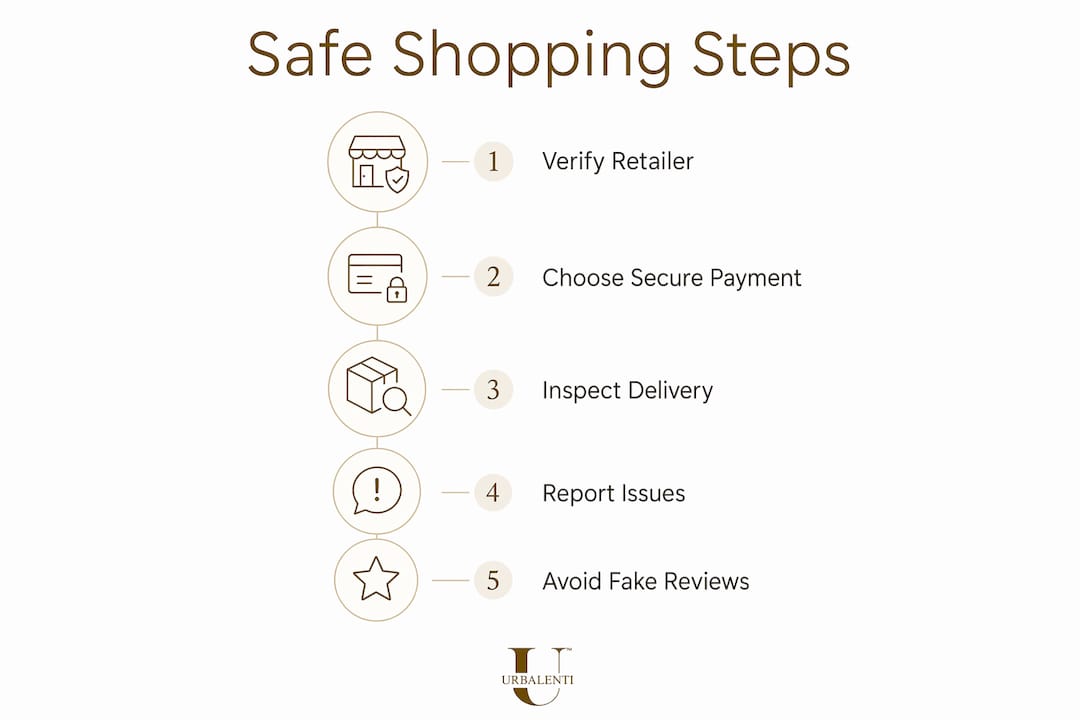
Secure payment is the second line of defense when you buy luxury apparel online. The payment method you choose determines how much protection you have if something goes wrong.
Follow these steps to protect every transaction:
On multi-boutique marketplace platforms, buyer protections vary by individual seller, not just the platform itself. Seller ratings and return policies differ across boutiques on the same platform, so each seller requires independent assessment before you commit to a purchase.
Pro Tip: Set a custom spending limit on your virtual card equal to the exact purchase amount. This prevents any additional charges from being processed on that card number.
The delivery inspection stage is where many buyers lose their protection window. The UK government advises a 48-hour inspection window after delivery to raise authenticity concerns and secure refunds or investigations. Waiting longer can forfeit your claim entirely.
Open your package as soon as it arrives. Work through this checklist:
Document everything with clear, close-up photographs before removing tags or wearing the item. These images serve as evidence for any dispute or authentication request.
| Inspection Area | What to Check | Red Flag |
|---|---|---|
| Stitching | Even, tight, consistent | Loose threads, uneven seams |
| Labels | Font, placement, material | Wrong font, misaligned text |
| Hardware | Weight, finish, engraving | Light, hollow, or blurred marks |
| Serial numbers | Present, cross-referenceable | Missing, generic, or unverifiable |
| Packaging | Brand-specific materials | Generic, thin, or faded |

Professional authentication services physically inspect craftsmanship, brand markings, and authenticity stamps. For high-value pieces, using one adds a layer of protection that no visual check alone can provide. Keep all original packaging and tracking documentation until you are fully satisfied with the purchase.
For a deeper understanding of what separates genuine pieces from counterfeits, the guide to authentic designer clothing covers the specific markers that matter most.
Most fraud incidents follow a predictable pattern. Knowing the mistakes in advance removes most of the risk.
“Safe online shopping combines technical checks with consumer skepticism at each purchase stage, from site visit to delivery inspection.” — GOV.UK guidance on spotting fake fashion
The most overlooked mistake is treating a low price as a neutral signal. Authentic Valentino, Emporio Armani, or Golden Goose pieces carry consistent market pricing. A retailer offering them at 60 to 70 percent below standard retail is almost certainly selling counterfeits or operating a payment fraud scheme.
The threat environment for online fashion shoppers has changed materially in the past two years. AI tools now let fraudsters build convincing fake storefronts faster than most consumers can detect them. The visual quality of counterfeit sites has reached a point where traditional advice, such as checking for a professional design or reading the about page, no longer provides real protection.
What actually works is verifying the business behind the website, not the website itself. Government registries, WHOIS data, and independent search results give you information that a scammer cannot easily fake. These checks take less than five minutes and eliminate the majority of fraudulent sites before you enter any payment information.
The second shift I have observed is the growing risk in marketplace platforms that aggregate independent boutiques. The platform name provides a sense of security that the individual seller may not deserve. Each boutique on a multi-vendor platform operates under its own policies, and the platform’s overall trust score does not transfer to every seller within it. Shoppers who treat the platform as a single trusted entity take on more risk than they realize.
Curation is the real answer to both problems. A retailer that selects its inventory carefully, sources directly from verified suppliers, and fulfills from a controlled location removes most of the variables that create fraud risk. Urbalenti™ NYC operates exactly this way. Every piece in the catalog is sourced and fulfilled from Milan, with no third-party boutique intermediaries. That structure eliminates the seller-level risk that makes marketplace shopping complicated.
The steps in this guide are not optional extras for cautious shoppers. They are the baseline for anyone spending real money on designer fashion online.
— Admin Urbalenti
Urbalenti™ NYC sources every piece directly and fulfills all orders from Milan, Italy. That means every item in the catalog, from a Saint Laurent handbag to a Fendi Vanity bag, passes through a single, controlled fulfillment process with no third-party boutique risk.
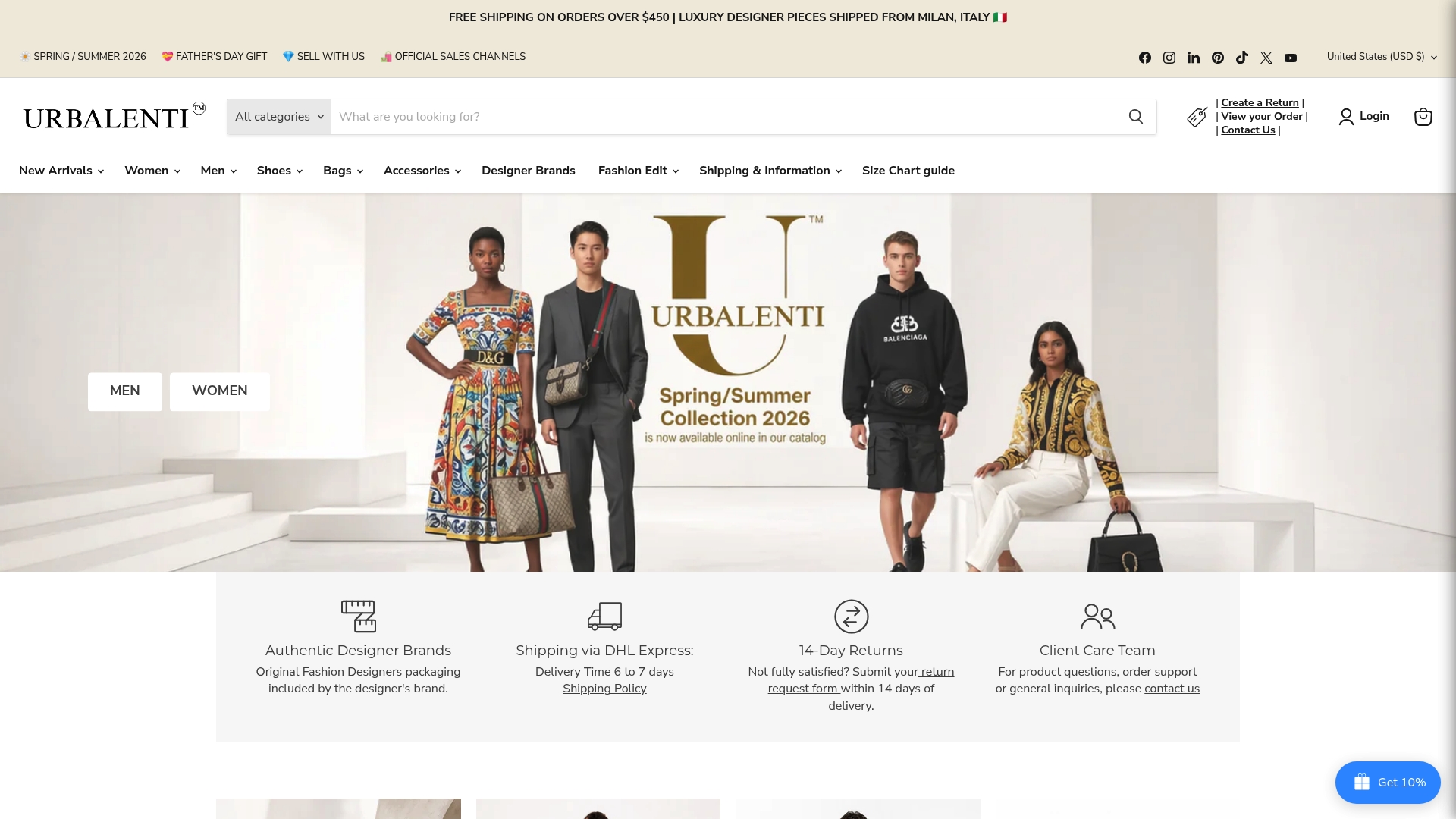
The catalog covers Saint Laurent, Valentino, Gucci, Givenchy, Emporio Armani, Golden Goose, and more. Every client receives personalized support from selection through delivery, with worldwide DHL Express shipping and transparent return policies. For shoppers who want to shop high-end fashion safely without running through a multi-vendor checklist, Urbalenti™ NYC offers a direct, verified path to authentic luxury fashion.
Check the retailer’s business registration in an official government registry, confirm the domain age using a WHOIS tool, and verify that the site uses HTTPS encryption. Independent search results and verifiable contact information are also required indicators of a legitimate operation.
Credit cards and virtual credit cards offer the strongest protection. Virtual cards use disposable numbers and spending limits, reducing fraud exposure. Never share one-time passwords or card details outside a secure transaction channel.
The UK government advises a 48-hour window after delivery to raise authenticity concerns and secure a refund or investigation. Acting within this window is the most effective way to protect your purchase.
Social media ads with positive comments should not be treated as proof of legitimacy. Fake reviews and fabricated comment sections are common fraud techniques. Always verify the retailer independently through official registries and trusted search engines.
Examine stitching quality, label fonts and placement, hardware weight and finish, serial numbers, and packaging materials. Photograph everything before removing tags. For high-value pieces, a professional authentication service provides additional verification beyond visual inspection.
Safe online shopping for authentic designer fashion requires verifying the business behind the website, using protected payment methods, and inspecting every delivery within the 48-hour window before your buyer protection expires.
| Point | Details |
|---|---|
| Verify the business, not the site | Check government registries, domain age, and HTTPS before any purchase. |
| Use virtual or credit cards | These limit fraud exposure and allow charge disputes if a product is counterfeit. |
| Inspect within 48 hours | The standard buyer protection window closes quickly; document everything on arrival. |
| Avoid marketplace seller risk | Buyer protections vary per boutique on multi-vendor platforms; assess each seller independently. |
| Choose curated retailers | Retailers that source and fulfill directly, like Urbalenti™ NYC, remove third-party fraud variables. |
Leave a comment