
MY WISHLIST
MY WISHLIST

Measure the ring’s inner circumference in millimeters, or measure the diameter and multiply by π, and use that number to read the equivalent size in any country’s system. That single measurement is the only universal reference across US, UK, EU, and Japanese sizing.
Two anchors to memorize now:
If you already know your circumference in millimeters, skip to the chart below. If not, grab a strip of paper or an existing ring and measure it before you order anything.
Ring size conversion works reliably only when you anchor every comparison to inner circumference in millimeters rather than converting directly between country labels.
| Point | Details |
|---|---|
| Measure in millimeters | Use circumference directly, or measure diameter and multiply by π to get circumference. |
| Memorize two anchors | US 6.5 ≈ 53.8mm ≈ EU 54 ≈ UK N; US 9.5 ≈ 61.4mm ≈ EU 61 ≈ UK T. |
| Repeat measurements | Measure three times at room temperature and use the most consistent reading. |
| Round up when between sizes | Choose the larger size for wide bands or rings that can’t be resized. |
| Check Urbalenti™ NYC listings | Product pages list mm circumference alongside designer sizing for accurate ordering. |
Every ring sizing system is really just a different label pasted onto the same physical measurement, and that measurement is inner circumference in millimeters. The EU and French systems state that number directly. EU 54 means the inside of the ring measures exactly 54mm around. German sizing works off the same ring but reports diameter instead of circumference, so a German size and a French size for the same physical ring look different even though nothing about the ring changed.
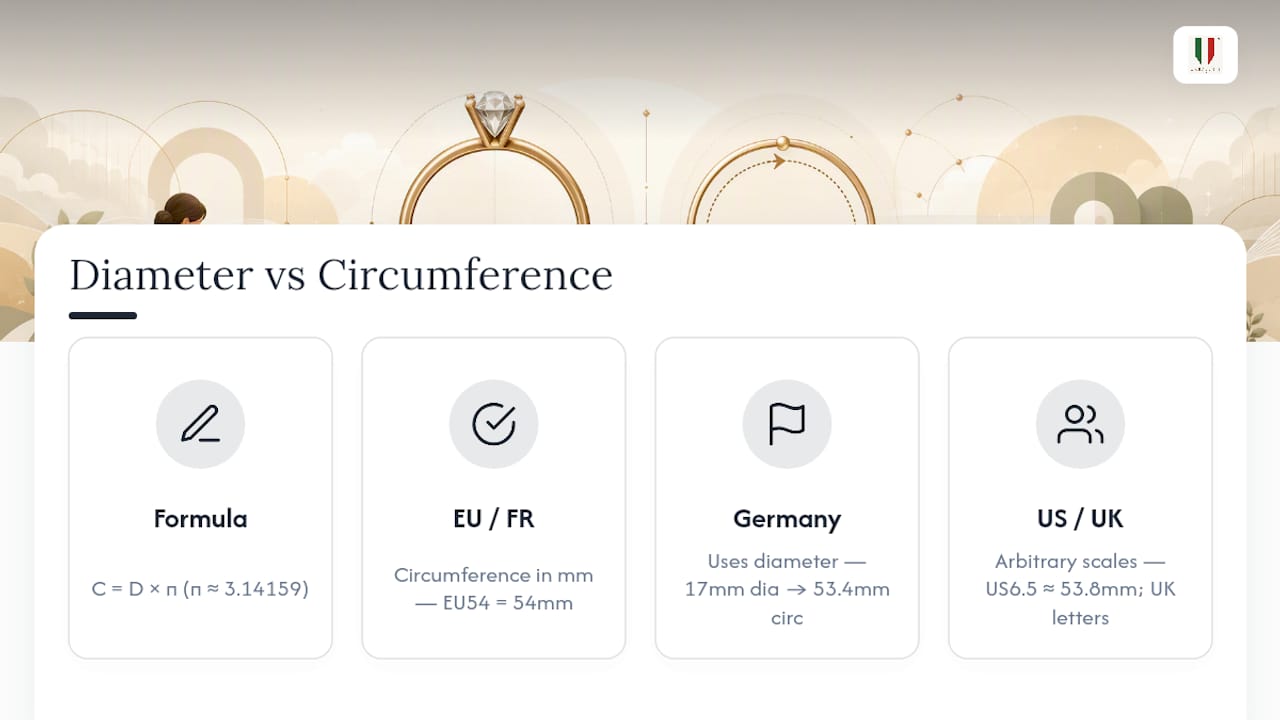
US, Canadian, and UK sizing don’t describe a physical dimension at all. They’re arbitrary scales (numbers for US/CA, letters for UK/AU/NZ) that only make sense once you look them up against a chart. That’s the catch: you can’t do math on a UK letter or a US half-size the way you can with a millimeter figure.
The formula behind every conversion is simple. Circumference equals diameter times pi (π, roughly 3.14159). Measure a ring’s inner diameter at 17mm, and the circumference works out to 17 × 3.14159, or about 53.4mm, which lands right around a US 6.5 / EU 54. That’s the same math the conversion calculators jewelers use rely on: feed in circumference or diameter, and the tool maps it to the nearest row in a regional reference table.
Statistic Callout: Global averages hover around US 6.5 (53.8mm) for women and US 9.5 (61.4mm) for men, based on aggregated international sizing data. Those two rows are worth memorizing since they cover the middle of most adult sizing charts and make a fast sanity check for any conversion you calculate yourself.
You don’t need a jeweler’s mandrel to get a trustworthy number. A plastic multi-sizer (the kind with a belt that loops and tightens), a narrow strip of non-stretch paper, a flexible millimeter tape, or an existing ring you already own that fits well will all get you there.
If you’d rather measure a ring you already own instead of your finger, measure the inner opening’s diameter, not the outer edge, and don’t include the metal band’s thickness in your number. Multiply that inner diameter by π to get circumference, then match it to the chart above.
Pro Tip: A plastic belt sizer gives more repeatable results than a paper strip because it doesn’t stretch or crease. If you’re using a printable sizer instead, hold it against a ruler before cutting; home printers frequently scale PDFs down by a few percent, and that small error is enough to throw off an entire size.
Here are conversions covering the range most shoppers actually need, from delicate stacking rings to men’s wedding bands.
| Circumference (mm) | Diameter (mm) | US | UK | JP |
|---|---|---|---|---|
| 46.8 | 14.9 | 4 | H 1/2 | 6 |
| 49.3 | —.7 | 5 | J 1/2 | 9 |
| 53.8 | 17.1 | 6.5 | N | 14 |
| 57.6 | 18.3 | 8 | Q 1/2 | 16 |
| 61.4 | 19.5 | 9.5 | T | 19 |
| 65.3 | 20.8 | 11 | X | 22 |
| 69.7 | 22.2 | 13 | Z 3/4 | 26 |
Half sizes step up in roughly 1.25 to 1.3mm of circumference each. That relationship holds fairly well through the middle of the chart, but simple shortcut formulas lose accuracy at the extremes — a very small child’s size or a very large men’s size won’t convert cleanly using a quick multiplier, so lean on the table rather than mental math at either end.
A few habits that prevent a wrong order:
A few practical rules matter more than the math once you get close to your actual size. Wider bands (anything past about 6mm) generally need to run a half size larger than a thin band would, simply because more metal touches more finger surface. Comfort-fit interiors, with their rounded inner edge, tend to feel roomier than a flat-inside band of the same labeled size.
Measure at room temperature, never right after a workout or in cold weather, and take readings at different points in the day since finger size shifts slightly with hydration and temperature. If your knuckle is noticeably larger than the base of your finger, measure both and choose a size that clears the knuckle while still sitting snugly at the base. And whatever printable sizer you download, check it against a ruler at 100% scale before trusting it. A resource like this luxury watch sizing guide covers similar fit principles for wrist accessories, and the same logic of measuring at rest, not after activity, applies here.
Urbalenti™ NYC lists inner circumference in millimeters as the reference measurement on ring product pages, alongside the designer’s original size labeling, so you’re never guessing which system applies. Every piece ships from Milan after a quality check that confirms sizing and authenticity before it leaves our fulfillment center.
If a piece is high value or not designed to be resized, reach out to customer service or request a virtual appointment before you order. A few minutes of sizing guidance is far cheaper than a return shipment.
Most sizing guides throw a dozen conversion columns at you and call it comprehensive. That’s backwards. The only number that actually behaves like a fixed unit of measurement is the millimeter circumference; everything else, US numbers, UK letters, is a lookup label sitting on top of it. Treat the mm figure as the one to write down and remember, not the US half-size that varies slightly from one country’s chart to the next.
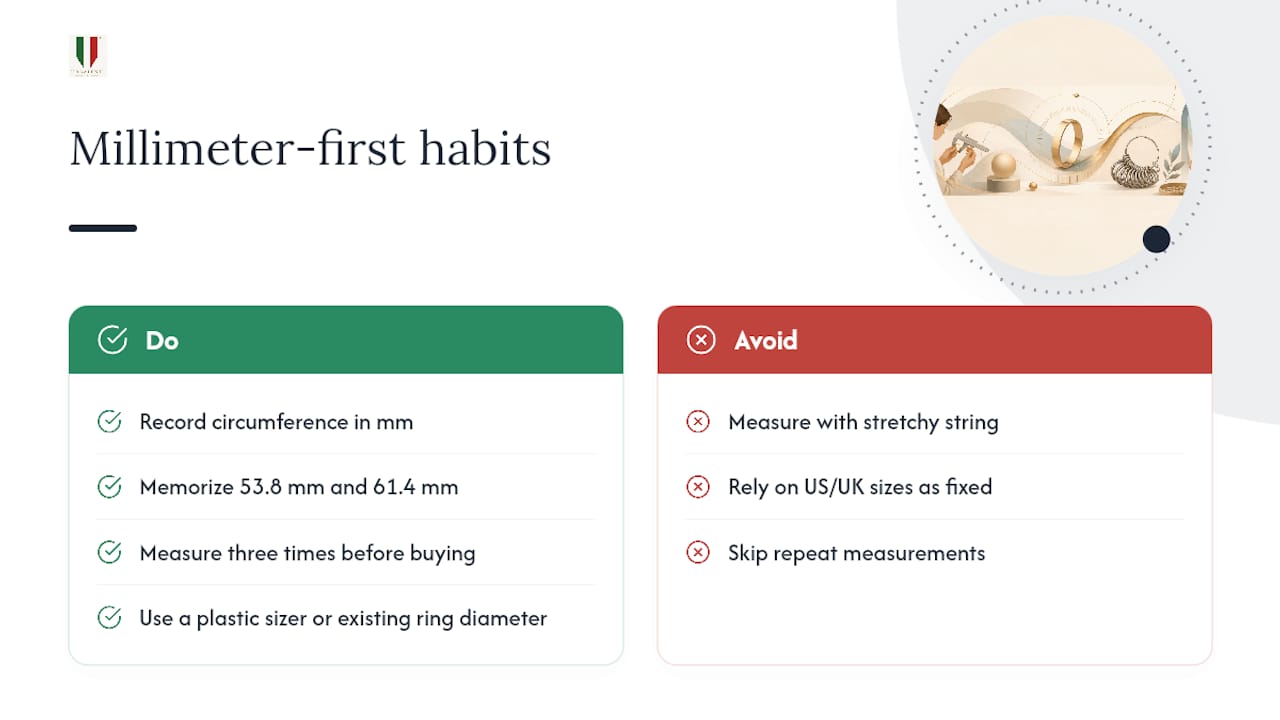
The conventional advice to “measure with a piece of string” undersells how much error that introduces. String stretches under tension, and a stretched loop reads smaller than your actual size, which is a common cause of rings ordered too tight. A plastic sizer or an existing ring’s inner diameter gives a cleaner number.
If you take one thing from this, memorize the two anchor rows (53.8mm and 61.4mm) and measure three times before you commit to a purchase. That habit alone prevents the majority of sizing-related returns, and it costs you five minutes.
— Admin Urbalenti™ NYC
Every ring on Urbalenti™ NYC lists its circumference in millimeters directly on the product page, next to the designer’s own size label, so you can match your home measurement without guessing which regional chart applies. Take the Maison Margiela Silver Silver Ring as an example: check the size details on that listing against the mm figure you measured at home before adding it to your cart.
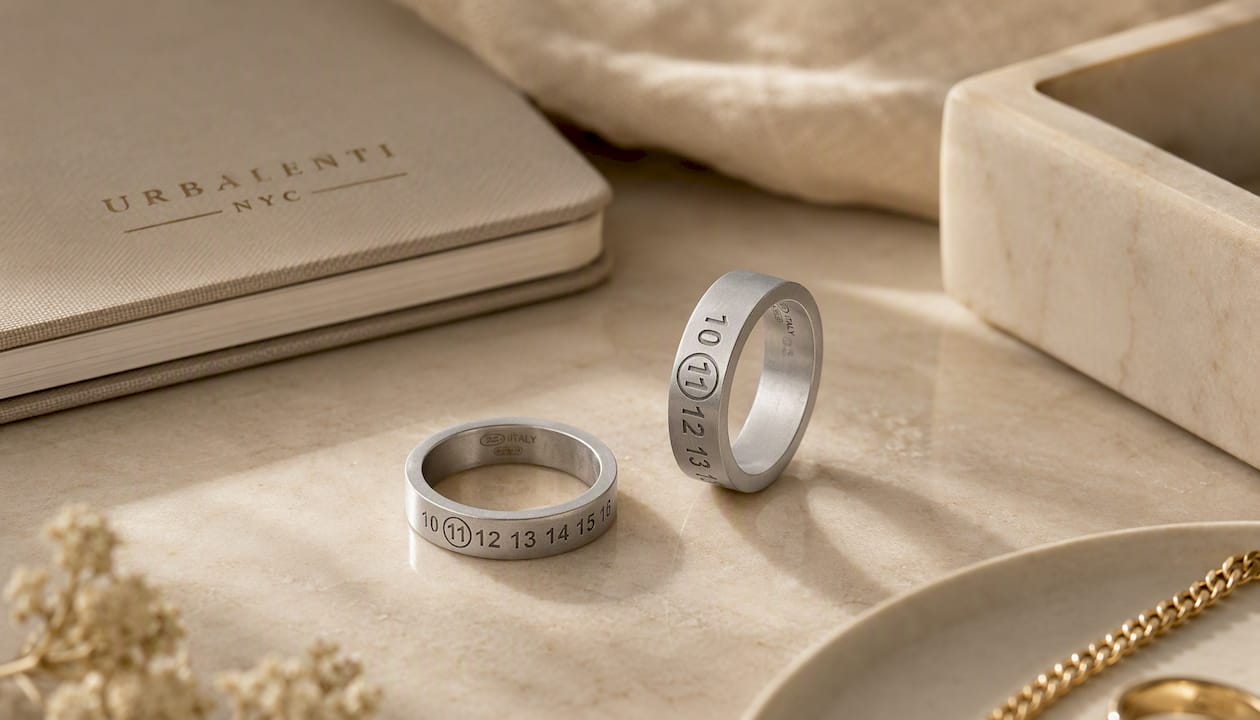
If your measurement falls between two sizes or you’re ordering a piece that can’t be resized later, contact our customer service team for sizing help before you check out. Every order ships from our Milan fulfillment center via DHL Express, and our return policy covers sizing issues on eligible pieces. Browse the full designer jewelry collection or check the alternate listing for the Maison Margiela Silver Silver Ring if your first choice shows limited stock, then place your order with your millimeter measurement already confirmed.
A US size 7 measures approximately 56.3 to 56.8mm in inner circumference, which corresponds to roughly EU 55 to 56 and UK O to O 1/2.
Wrap a plastic sizer, non-stretch paper strip, or existing ring’s inner opening snugly around your finger, mark the overlap, measure in millimeters, and repeat three times to confirm consistency.
Seven inches equals about 177.8mm, which is far larger than any standard finger ring; if you’re measuring in inches, convert to millimeters first (1 inch = 25.4mm) before comparing against a sizing chart.
A US size 9 measures about 59.5mm in circumference, or roughly 2.34 inches; converting to millimeters first is more accurate since most charts, including Urbalenti™ NYC’s product listings, use mm as the base unit.
Leave a comment