
MY WISHLIST
MY WISHLIST

Last Updated: October 30, 2026
Quick Summary
Real alternatives to designer leather belts for men include vegan leather, woven, and canvas styles that add material variety to a rotation. Most men need one formal leather belt, one woven belt, one casual canvas belt, and one seasonal option rather than more leather.
The belt is the most overlooked piece in a man's wardrobe, and that is exactly why it deserves a second look. At URBALENTI, we handle a steady stream of questions from men who own three or four designer leather belts and still feel their rotation is thin. The problem is rarely quality. It is range. A closet built entirely around smooth calf leather in black and brown handles boardrooms and weddings, then falls apart the moment a man needs something for linen trousers in July or a weekend in worn denim.
That gap has widened as wardrobes have loosened. Tailoring is softer, trousers are wider, and the sneaker has settled permanently into everyday wear. A stiff, high-shine leather belt can look out of place against that backdrop. Men are also reading labels more carefully, asking where materials come from and whether a piece will last long enough to justify its cost. For readers weighing that broader question, our guide to sustainable luxury footwear brands for men covers similar ground in shoes.
A belt rotation is not about owning more. It is about owning the right three or four. Most men need one formal leather belt for suits, one textured or woven belt for smart-casual, one casual belt for denim and chinos, and one seasonal option in a lighter color or material. Get those four right and you stop thinking about belts entirely.
The case for alternatives to mainstream designer leather belts for men rests on three practical points. First, material variety solves styling problems leather cannot. Second, non-leather options often cost less while lasting comparably. Third, a mixed rotation reads as considered rather than branded. The rest of this guide breaks down each category, what it does well, and where it falls short.
Each material serves a distinct purpose, and the fastest way to choose is to match the belt to the trousers it will sit against most often. The table below summarizes how the four main categories compare on the factors that matter most.
| Material | Best For | Durability | Formality | Price Band | Care |
|---|---|---|---|---|---|
| Smooth calf leather | Suits, dress trousers | Very high, improves with age | Formal to smart-casual | Higher | Condition twice yearly |
| Vegan leather | Everyday wear, travel | Moderate, depends on backing | Smart-casual | Lower | Wipe clean |
| Woven | Summer tailoring, texture | High if elastic core holds | Smart-casual | Mid | Spot clean only |
| Canvas | Denim, chinos, weekends | High, washes well | Casual | Lowest | Hand wash, air dry |
Leather wins on longevity and formality. Vegan leather wins on cost and ease. Woven belts win on texture and breathability. Canvas wins on ruggedness and casual styling. A rotation that covers all four is more useful than four leather belts in four shades of brown.
Men's vegan leather belts have improved dramatically, but quality varies more than in any other category. The best modern versions use a polyurethane (PU) coating over a woven fabric backing rather than the thin PVC of a decade ago. That construction resists cracking at the buckle end, which is where cheap vegan belts fail first. The weakest versions are solid PVC or a PU layer bonded to a non-woven core; they flex poorly, trap heat, and peel at the fold points within a season or two.
Do they hold up? For daily wear over two to three years, yes, if you buy well. They will not develop the patina of calf leather, and the coating can peel at flex points over time. Treat them as a practical, lower-cost option rather than an heirloom. The honest lifecycle picture: a good PU-over-woven belt is repairable at the buckle and tip by a cobbler, but the strap itself is not resoleable or rebuildable the way a full-grain leather belt is. End-of-life options are limited, most municipal textile recycling streams accept belts, but few brands run take-back programs for small leather goods, so ask before you buy.
Watch out: many belts labeled "vegan leather" are simply PVC with a marketing upgrade. Check the composition line before buying, and avoid anything that lists only "synthetic leather" with no further detail. A useful test is to bend the strap sharply at the buckle end in the store, a quality PU-over-woven belt will flex and recover, while a PVC belt will crease white.
Men's woven belts solve a specific problem: how to hold up lightweight trousers without the visual weight of a leather strap. Most are braided or stretch-woven around an elastic core, which gives a small amount of give as you move and sit. That elasticity is the reason they pair so well with linen, cotton, and unstructured summer tailoring.
Ferragamo Calf Leather Regular Belt for Men →
The trade-off is structure. A woven belt will not hold a heavy wool trouser with the same authority as leather, and the elastic core is the failure point on cheap versions. Look for a braided construction with a leather-trimmed tip and a metal buckle, and check that the weave feels tight rather than loose. Woven belts in tan, navy, and olive cover most warm-weather wardrobes.
Men's canvas belts are the most underrated option in the rotation and the cheapest to get right. A cotton canvas strap with a simple metal buckle handles denim, chinos, shorts, and weekend wear without complaint. Canvas takes color well, so it is the easiest way to introduce a belt that actually shows against dark trousers.
Durability is genuinely good. Canvas washes, resists scuffing, and does not crease the way leather does. The limits are formal: a canvas belt has no place under a suit, and a very casual webbing strap can look sporty rather than considered. For a designer take on the category, the Gucci beige cotton regular belt shows how a canvas strap can still read as luxury when the hardware and finish are right.
Styling a belt with tailored trousers comes down to three rules: match the formality, match the width to the trouser, and let the buckle stay quiet. A 3 cm leather belt in black or dark brown is the default for suits. A woven or suede belt works with softer, unstructured tailoring. The belt should sit at the natural waist, not ride below it, and the tip should reach the first loop past the buckle.
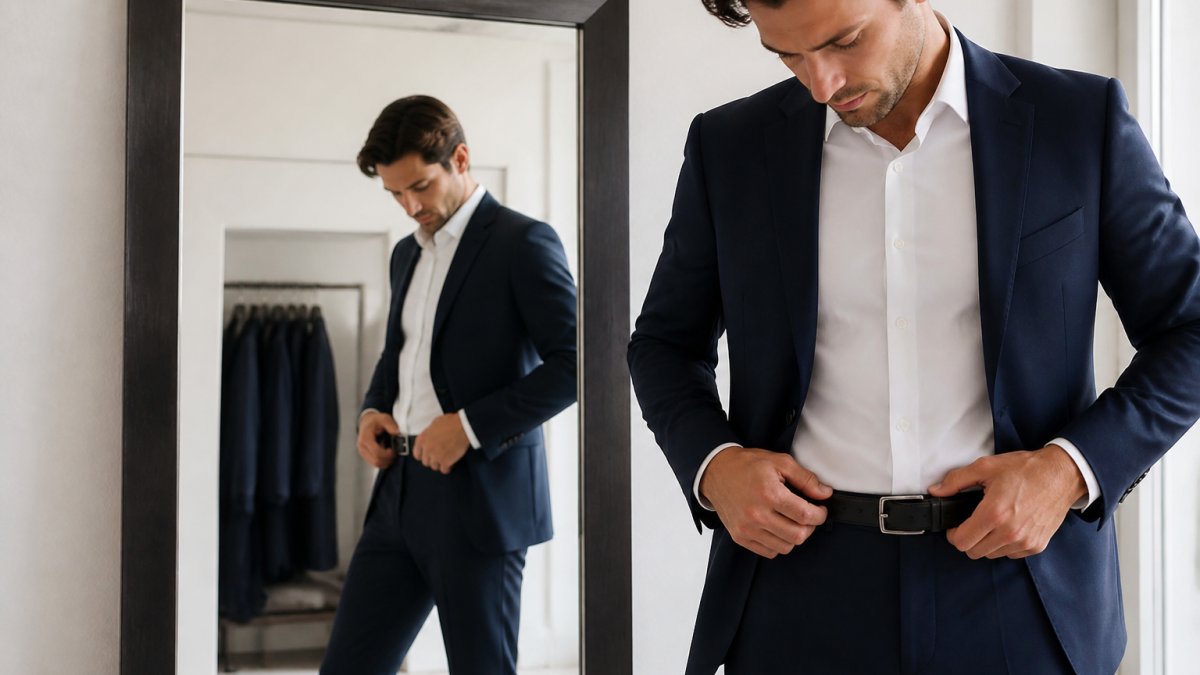
Buckle choice matters more than most men admit. A large logo buckle pulls attention to the waist and fights with a pocket square or a patterned shirt. A smaller, quieter buckle reads as more confident with formal wear. Trouser rise changes the calculation too: high-rise trousers sit closer to the natural waist and suit a narrower belt, while low-rise trousers need a slightly wider strap to look balanced.
Watch out: wearing a casual canvas or woven belt with a suit is the most common styling error we see. If the trousers have a crease, the belt should be leather or suede.
Construction is where the price difference lives, and it is visible if you know where to look. A well-made luxury belt uses a single piece of full-grain leather, cut from the center of the hide so the strap does not stretch unevenly. Cheaper belts are often split leather or bonded layers, which delaminate at the edges over time.
Hardware is the second tell. Solid brass or steel buckles hold their finish; plated zinc pits and flakes. Stitching should be tight, even, and slightly recessed. Edges should be painted or burnished in thin, clean layers rather than coated in a thick plastic seal that peels.
Reversibility is a practical luxury feature worth noting. Several Ferragamo styles in our collection are reversible and adjustable in length, which effectively gives two belts in one and lets the wearer fine-tune the fit. That kind of construction detail is what separates a belt designed to last from one designed to sell.
Value in a belt comes down to cost per year of wear, not sticker price. A leather belt at the higher end of the market costs more upfront but can last a decade with basic care, which works out to a modest annual cost. A vegan or canvas belt costs far less but typically needs replacing every few years. The mistake most shoppers make is comparing sticker prices across materials instead of comparing expected years of wear, repairability, and resale or hand-me-down potential.
A practical way to run the comparison is to score each option on four factors: expected lifespan, repairability, care cost, and versatility. Leather scores highest on lifespan and repairability, a cobbler can re-stitch, re-punch, or replace a buckle, and full-grain straps can be conditioned indefinitely. Woven belts score well on versatility but fail at the elastic core, which is rarely repairable. Canvas scores highest on durability per dollar but lowest on formality range. Vegan leather sits in the middle: lower entry cost, moderate lifespan, limited repairability.
Repairability is the factor most buyers overlook, and it is where luxury construction earns its premium. A belt with a stitched, screw-attached buckle can be rebuilt; a belt with a glued or riveted buckle usually cannot. Before buying, check whether the buckle is removable, whether the tip is stitched or sealed, and whether the maker offers any repair or replacement service. Those details matter more than the logo on the hardware.
Our luxury shopping guide for urban professionals walks through how to build a wardrobe around fewer, better pieces, the same principle applies to belts.
Ferragamo Calf Leather Regular Belt for Men →
For readers who want to stay within designer leather while broadening the rotation, a few pieces stand out for construction and versatility. These are the belts we would point a friend toward first.
Ferragamo remains the strongest entry point for reversible construction. The Ferragamo brown calf leather Bos Taurus regular belt pairs the house's Gancini buckle with adjustable length, so the fit can be tailored precisely. The Tom Ford black calf leather Bos Taurus belt takes a different route: a bold metallic T buckle and smooth calf finish for men who want the hardware to carry the look.
Gucci offers a reversible Cut GG Marmont belt that switches between coated GG fabric and leather, giving two distinct looks from one piece. Miu Miu leans workwear with a textured brown calf strap, contrasting stitching, and side hook loops, a more directional option for casual tailoring.
| Belt | Material | Width | Standout Detail | Best For |
|---|---|---|---|---|
| Ferragamo Gancini reversible | Calf leather | 3.2 cm | Knurled ruthenium buckle, adjustable | Formal and everyday |
| Tom Ford T-buckle | Calf leather | 3 cm | Bold metallic T hardware | Statement smart-casual |
| Gucci GG Marmont reversible | Calf leather and coated fabric | 3.5 cm | Two looks in one | Versatile rotation |
| Miu Miu workwear | Calf leather | 4 cm | Contrast stitching, hook loops | Casual tailoring |
Best for: men building a leather core who want hardware and construction to justify the spend. Skip if: you already own several smooth leather belts and need material variety instead.
Use this framework to narrow the choice in under five minutes. Start with the trousers you wear most, then work backward to material and width.
Run through that list honestly and the answer usually becomes obvious. Most men discover they do not need another leather belt at all. They need one woven and one canvas option to complete a rotation that already works.
The real challenge is not finding alternatives to mainstream designer leather belts for men. It is building a rotation where each belt earns its place. URBALENTI curates authentic designer accessories sourced through established European suppliers, with free shipping for U.S. customers, import duties included in the price, and a free exchange option if the fit is not right. Browse the belt collection to compare reversible Ferragamo styles, Tom Ford hardware, and Gucci's two-in-one construction, then choose the piece that fills the actual gap in your wardrobe.
Men's vegan leather belts, woven belts, and canvas belts are the three most practical alternatives. Vegan leather offers a similar look and feel without animal hide, woven belts provide breathability and texture for warm weather, and canvas belts suit casual and workwear outfits. Each serves a different purpose in a wardrobe, so many men keep one of each rather than replacing leather entirely.
Men's vegan leather belts can be a strong alternative if you prioritize animal-free materials or want a lower price point. Quality varies widely: look for belts with a solid buckle, clean edge finishing, and a backing that resists cracking. They may not develop the same patina as calf leather over time, but for casual and everyday wear they perform well.
A slim belt, roughly 3 cm wide, in a color that matches your shoes is the safest choice for tailored trousers. How to style a belt with tailored trousers comes down to proportion: the belt should sit flat against the waistband without bulging, and the buckle should be simple enough not to distract from the suit. Ferragamo's Gancini belts at 3 cm width are a good example of this proportion.
Men's woven belts are generally too casual for formal suits, but they can work with smart-casual tailoring like linen trousers or an unstructured blazer. Choose a woven belt in a dark, solid color with a leather-trimmed buckle to bridge the gap. Avoid pairing them with worsted wool suits or formal occasions.
Yes, if you choose carefully. Ferragamo's Gancini buckle is subtler than a large logo plate, and Tom Ford's suede belt with a silver-tone buckle keeps branding minimal. Designer belts in the $489 to $669 range offer construction quality, adjustable lengths, and reversible options that extend their versatility, making them worth considering even if you prefer understated branding.

Leave a comment