
MY WISHLIST
MY WISHLIST

For extreme cold, a long expedition parka with high fill power and sealed seams wins every time. For daily city wear, a mid-length designer parka with a weatherproof shell and hydrophobic down performs and looks the part. For commuting or travel, a lightweight, packable insulated shell with a strong DWR finish covers most winter days. Our curated selection includes a range of parkas, prioritizing authentic construction over marketing claims.
TL;DR:
- A mid-length down parka with hydrophobic fill is ideal for most urban winter wear, offering protection in damp conditions without bulk.
- For extreme cold, a knee-length expedition parka with 750-fill down and welded seams provides the best insulation and wind resistance.
- Waterproof or membrane-shell parkas with sealed seams are essential for wet environments, while DWR coatings need reapplication over time.
- Proper fit involves layering considerations; measure chest, shoulders, and sleeves, and choose sizes accommodating typical winter clothing without restriction.
- Maintenance includes gentle washing with down-safe detergent, regular reproofing, and storing loosely to preserve loft and insulation integrity.
Choosing among the best winter parkas for men comes down to matching construction to conditions, not chasing the highest fill-power number on a spec sheet. Independent testing from outlets like Outdoor Gear Lab consistently shows that treated down and sealed shells outperform raw high-fill insulation once wind and moisture enter the picture. That single fact should shape every purchase decision below.
The shortlist that follows organizes parka approaches by the job they do best, rather than ranking specific brands against each other. Guides like Better Trail’s 2026 roundup use a similar superlative structure (best overall, best value, best for extreme cold) because it mirrors how people actually shop for seasonal outerwear.
Best overall approach: mid-length down parka with hydrophobic fill. This is the parka most men should own if they only buy one. A mid-thigh length, 550 to 700 fill power hydrophobic down, and a durable water-repellent shell cover commuting, weekend errands, and moderate cold without the bulk of an expedition coat. The technical reason it works across so many situations: treated down resists the moisture that collapses loft, so the coat keeps insulating even in damp snow or light rain. Fit tip: size for one mid-layer, not a bulky sweater, since most urban use doesn’t demand heavy layering. Check the fill power rating and whether the down carries a hydrophobic treatment before buying, since untreated down loses warmth fast once wet.
Best for extreme cold: long expedition parka with high-fill down and welded seams. Anyone facing sustained sub-zero temperatures, high winds, or multi-day outdoor exposure needs a knee-length or near-knee-length parka built the way Shackleton’s Lockroy Parka is built: 750-fill down, welded seams, sealed construction, and a storm cuff. The technical reason: at that fill power, the down traps dramatically more warm air per ounce, and welded seams stop wind and moisture from finding a way in through stitch holes. Fit tip: buy slightly roomier through the shoulders to accommodate a heavy base and mid-layer combination. Check seam construction closely. Stitched-and-taped seams are fine for city cold; welded or fully sealed seams matter once you’re facing real wind chill.
Best urban and designer approach: tailored-silhouette parka with technical detailing. Design-focused labels have gotten good at hiding real protection inside a clean silhouette, insulated hood, and draft tube tucked behind the zipper rather than a construction that shouts “outdoor gear.” The technical reason this works: draft tubes and insulated hoods do the heavy lifting on warmth, so the outer shell can prioritize drape and proportion instead of rugged texture. Fit tip: this category runs closer to the body than expedition parkas, so try it over your typical layering combination before committing to a size. Check that the hood adjusts and that the front closure has a wind-blocking placket, since some designer parkas cut this feature to preserve a cleaner front.
Best waterproof or technical approach: membrane-shell parka with taped seams. For men facing sleet, slush, or coastal wind rather than dry powder cold, a membrane shell (rather than DWR-treated fabric alone) becomes the priority. The technical reason: a membrane blocks water penetration under sustained pressure, while DWR coatings alone wear off with repeated exposure. Fit tip: membrane shells trap more moisture from your own body heat, so look for pit zips or mesh-lined pockets that help vent it. Check the membrane’s breathability rating if the parka will see active use, since a non-breathable shell turns clammy fast during a brisk walk.
Best packable commuting approach: lightweight insulated shell with strong DWR. Travelers and commuters who need warmth without bulk should look for synthetic or low-loft down insulation in a shell that compresses into a bag. The technical reason it works for this job: synthetic insulation and lower fill-power down pack smaller and recover faster after compression than a high-loft expedition parka, which loses some structure if stuffed too often. Fit tip: buy this style true to size or even slightly fitted, since it’s meant to layer under a heavier coat on the coldest days, not replace one. Check the DWR finish date and reapplication instructions, since packable shells rely almost entirely on that coating for weather resistance.
Best value approach: synthetic-insulated parka with solid construction basics. Synthetic fill costs less than comparable down and performs better when wet, making it the practical choice for men who don’t want to fuss over storage and drying. The technical reason: synthetic fibers hold their structure even when saturated, while down clumps and loses loft. Fit tip: synthetic insulation is often bulkier per unit of warmth, so size the shoulders and arms for mobility rather than a slim look. Check stitch density at stress points (cuffs, pocket corners) since budget-focused synthetic parkas sometimes cut corners there before they cut corners on the fill itself.
Start with the use case, then let the required specs follow from it. A commuter walking eight to fifteen minutes between transit and an office needs far less parka than someone standing outside for hours or hiking in exposed conditions.
Pro Tip: Don’t buy warmth you’ll never use. A 750-fill expedition parka is overkill for a five-minute walk to the subway, and the extra bulk will actually make you sweat and then chill once you’re inside.
Before checkout, run a quick purchase checklist: confirm the fit accommodates your typical layering, ask whether the seller offers repair or reproofing support, and check what warranty or return policy backs the purchase. A parka is a multi-year investment, and the aftercare options matter almost as much as the specs on day one.
Warmth is a system, not a single spec. A 750-fill down parka with weak construction will lose heat faster than a well-built 600-fill parka, because insulation, shell, construction, and fit all have to work together to trap air and block wind.
Down behaves differently depending on treatment. Loft, the fluffiness that traps warm air, is what makes down effective, and fill power measures how much loft an ounce of down produces. Untreated down performs beautifully when dry but collapses when wet, since water weighs down the individual plumes and eliminates the air pockets that create insulation. Hydrophobic-treated down, the kind referenced in The North Face’s Summit Series Himalayan Down Parka, resists that collapse by coating individual down fibers so moisture beads off rather than soaking in.
Synthetic insulation earns its place in wet or active conditions. It won’t match down’s warmth-to-weight ratio at the top end, but it keeps insulating when saturated and dries faster, which makes it the smarter choice for slushy commutes, heavy activity, or climates where rain is more common than dry snow.
Shell technology decides how much of that insulation you actually get to keep. DWR coatings are efficient and lightweight but degrade with wear and need periodic reapplication. Waterproof membranes, and recycled-content shells increasingly common across the category, hold up longer under sustained moisture but trade away some breathability. Neither is universally better. The right choice depends on whether you’re facing dry cold or wet cold.
Construction is where warmth quietly gets lost or saved. Baffle geometry, the internal stitching pattern that creates down-filled chambers, determines whether insulation shifts and creates cold spots over time. Welded seams and internal draft tubes, the insulated flap running behind the main zipper, block the wind infiltration that stitched-only seams allow. Per-shoulder baffle reinforcement and taped seams at the hood are small details that separate a parka that’s warm in the city from one that’s warm on an exposed ridge in a storm.
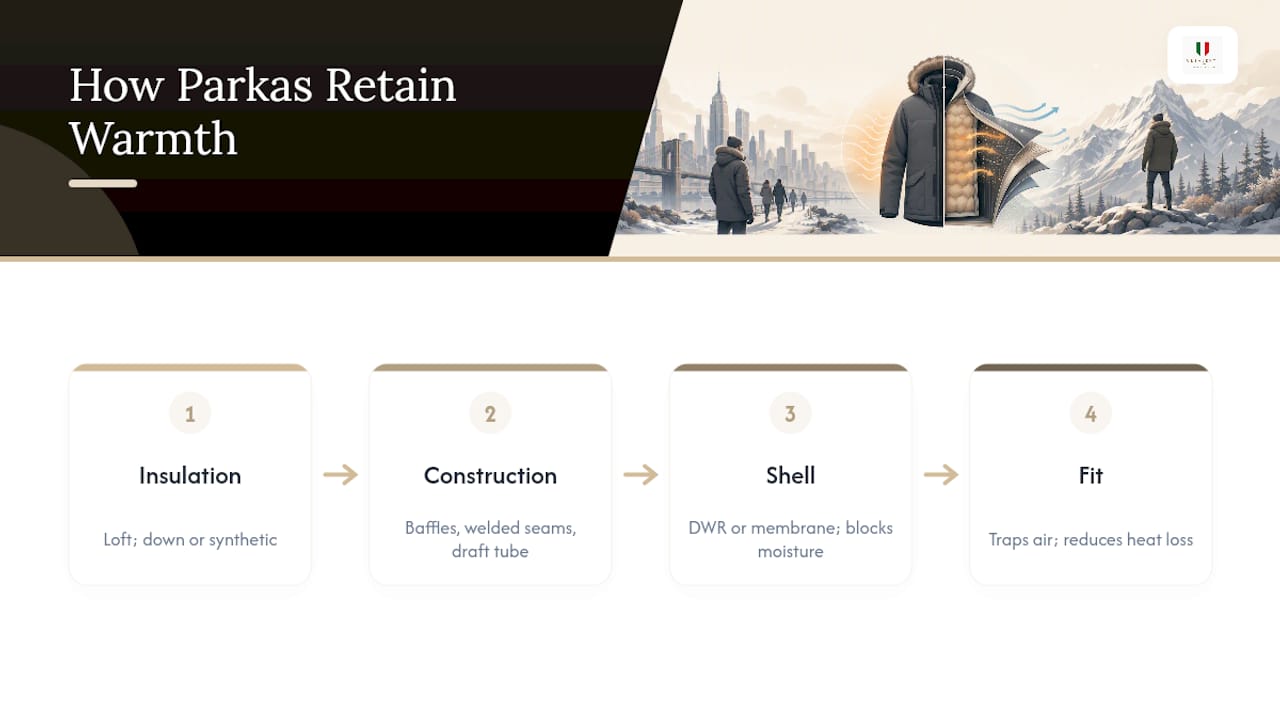
A parka that fits perfectly with no layers underneath is usually a parka that fits poorly once winter actually arrives. Measure your chest, shoulders, and sleeve length first, then add roughly one to two inches of chest allowance for a base layer and light sweater, or closer to three inches if you plan to layer a heavier mid-layer underneath.
Length matters as much as width. A mid-thigh parka works for most daily wear and still allows a full stride when walking or climbing stairs. A knee-length or longer cut suits genuinely brutal cold and static outdoor time, but it can look heavy paired with tailored trousers unless the silhouette is cut close through the body.
If you’re shopping online, check the brand’s measurement chart against your own numbers rather than relying on size labels alone, since cut varies significantly between technical and design-focused labels. Partner resources like this detailed hoodie and layering fit guide walk through the same chest-step measuring logic that applies to outerwear, and it’s worth the five minutes before you commit to a size you can’t try on in person.
Try-on checklist: raise both arms overhead to confirm the sleeves and shoulders don’t restrict movement, zip the coat fully closed over your typical layering setup, and sit down to make sure the length doesn’t bunch or ride up uncomfortably.
Down and synthetic insulation both survive for years with the right care, and most damage comes from improper washing or long-term compression rather than normal wear.
Pro Tip: Reproof your parka’s DWR at the start of the season, not mid-winter when you notice it failing. A fresh coating applied before the first real storm outperforms one applied reactively after the shell has already soaked through once.
The gap between a parka that reads as gear and one that reads as designer outerwear usually comes down to silhouette, color, and what you pair it with, not the insulation inside it.
A well-constructed parka from a piece like the Lemaire waterproof jacket demonstrates how a clean shell finish and considered proportions let outerwear function inside a design-forward wardrobe rather than fighting against it.
Every outerwear piece in Urbalenti NYC’s collection ships direct from Italy, with U.S. import duties and taxes already included, and EU VAT included for European orders, so the price shown at checkout is the price paid. That transparency matters more with outerwear than almost any other category, since parkas and heavy coats are exactly where surprise fees tend to hit hardest at delivery.
Curation for outerwear focuses on the same balance this guide walks through: real insulation and shell performance alongside a silhouette that holds up in a design-conscious wardrobe. A piece like the Brunello Cucinelli sleeveless jacket in beige polyester shows the fabric and construction standard applied across the layering pieces in the catalog, and the Y-3 padded hoodie illustrates how padded insulation gets handled at the athletic-luxury end of the spectrum.
Authenticity verification runs on every piece before it reaches a customer, a standard covered in more depth in Urbalenti NYC’s guide to buying authentic Moncler padded outerwear. Admin Urbalenti™ NYC oversees the editorial and sourcing standards behind these guides, applying the same evaluation lens (insulation quality, shell construction, and design integrity) to every outerwear piece added to the collection.

Sustainability in outerwear generally shows up in two places: the insulation source and the shell fabric. Down sourced under animal welfare certifications addresses concerns around live-plucking and force-feeding practices in the supply chain, and increasingly, brands disclose this sourcing directly on product pages rather than leaving it to third-party claims.
Recycled-content shells, often recycled polyester or nylon blends, reduce reliance on virgin petroleum-based fabric without sacrificing DWR performance. Synthetic insulation made from recycled fibers offers a cruelty-free alternative to down entirely, which matters to buyers who want warmth without any animal-derived material in the coat.
None of these choices require sacrificing performance. A well-constructed synthetic parka with a recycled shell can outperform a poorly built down coat in wet climates, and certified down performs identically to uncertified down since the certification addresses sourcing ethics, not insulation quality. The honest advice here: check the product page for specific certification language rather than assuming a “sustainable” label means anything concrete, since the term gets used loosely across the outerwear category.
Brand reputation matters less for warmth than for consistency and aftercare. A well-known technical brand and a design-focused luxury house can both produce a genuinely warm parka. Where reputation earns its keep is in construction consistency across production runs, honest fill-power labeling, and what happens if a zipper fails or a seam opens after a season of wear.
Warranty coverage varies enormously across the category. Some outdoor-focused brands offer lifetime repair programs on core outerwear, while design-focused labels typically offer standard limited warranties tied to manufacturing defects rather than wear and tear. Before buying, it’s worth checking what the specific warranty covers rather than assuming “premium price” automatically means “premium aftercare.”
Authenticity matters just as much as warranty terms, particularly when shopping designer outerwear online, since counterfeit parkas mimic the look but rarely replicate the fill power, seam sealing, or shell treatment that make the real version worth the price. Buying from a source that verifies authenticity before shipping removes that risk entirely, which is a bigger practical safeguard than any printed warranty card.
Most parka advice treats fill power like the only number that matters, and that’s backwards. A 750-fill parka with weak seam sealing and no draft tube will lose a fight against wind chill to a well-constructed 600-fill coat every time. The conventional wisdom oversells insulation and undersells construction, and it’s construction, the welded seams, the draft tubes, the baffle geometry, that actually separates a parka that survives a real storm from one that just photographs well.
The other place conventional advice falls short is treating designer and technical outerwear as separate categories entirely, as if style and performance can’t coexist in the same coat. They can, and increasingly do. Prioritize the construction details first, the shell technology second, and let silhouette and finish guide the final decision between options that already meet your warmth requirements. That order gets you a coat that performs and looks right, instead of one that does only one of those things well.
— Admin Urbalenti™ NYC
Urbalenti NYC gives you a straightforward alternative to guessing at authenticity on marketplace listings: every parka and outerwear piece ships direct from Italy with U.S. import duties and taxes already included, so there are no surprise fees waiting at delivery.

Browsing the collection is simple. Filter by category, brand, or size on the shop page, check the product listing for fabric and construction details, and reach out directly if you’re hunting for a specific piece not currently listed. Curated pieces like the Versace bordeaux silk pattern shirt show the same authenticity standard applied across categories beyond outerwear, and the Brunello Cucinelli bordeaux cashmere cardigan makes a strong layering companion under a mid-length parka once temperatures drop. If you’re building a full cold-weather wardrobe, the Brunello Cucinelli bordeaux cotton sweatshirt pairs cleanly with tailored outerwear for a commute-ready look. Start browsing the current outerwear selection and check sizing against your own measurements before checkout.
The warmest parkas combine high fill power (700 or above), hydrophobic-treated down, and sealed or welded seams, since construction determines whether that insulation stays effective in wind and moisture. A high-fill parka with weak seam sealing will underperform a lower-fill parka built with proper draft tubes and taped seams.
No single brand makes the best parka for every buyer. Technical outdoor brands lead on extreme-cold construction, while design-focused labels lead on silhouette and versatility for daily wear. The right choice depends on matching construction quality to your specific use case, whether that’s expedition cold or a daily commute.
Top-rated coats consistently share three traits: hydrophobic or synthetic insulation that resists collapsing when wet, a DWR or membrane shell, and sealed seams at the hood and body. Urbalenti NYC curates designer options that meet these same technical standards while fitting a luxury wardrobe.
There’s no universal best brand, since the right pick depends on whether you prioritize expedition-grade warmth, daily urban styling, or packable travel use. Compare construction details like seam sealing and fill power treatment rather than brand name alone before deciding.
Affordable parkas with synthetic insulation and solid basic construction (sealed seams, quality zippers) can outperform expensive down parkas in wet conditions, since synthetic fill resists moisture better than untreated down. Price alone doesn’t guarantee performance, so check the construction details before comparing cost.
Editorial Note: Product availability, pricing, and shipping conditions may change. All products featured by URBALENTI™ NYC are 100% authentic and original. Please refer to the applicable product page and store policies for current details.
Leave a comment