
MY WISHLIST
MY WISHLIST

A currency conversion fee is the markup a bank, card network, or payment processor adds on top of the real exchange rate when you spend or withdraw money in a foreign currency. A foreign transaction fee is a separate surcharge your card issuer charges just for processing a purchase outside your home currency, regardless of the exchange rate used. The single move that avoids most of the damage: pay in the local currency, always decline dynamic currency conversion, and carry a card with no foreign transaction fee.
TL;DR:
- Using a card that has no foreign transaction fee and always paying in the local currency can significantly cut conversion costs.
- Declining dynamic currency conversion at ATMs and merchant terminals prevents paying inflated rates and double charges.
- Specialist transfer services typically add only around 0.4% to 0.6% over the mid-market rate, making them a cheaper option for large sums.
- ATM flat fees of $3 to $5 per withdrawal can be minimized by withdrawing larger amounts less frequently and avoiding excess small trips.
- On high-value purchases, comparing total landed costs, including duties and conversion markups, ensures clearer budgeting and avoids hidden expenses.
Every currency has a mid-market rate, the real exchange rate you’d see on a financial data terminal with no markup attached. Banks, card networks, and payment processors almost never give you that rate. They add a percentage on top, pocket the difference, and call it a conversion fee.
The formula is simple: markup percentage = (rate you’re charged − mid-market rate) ÷ mid-market rate × 100. Say the mid-market rate is $1.00 = €0.92, but your bank converts at $1.00 = €0.90.
Several parties can add this markup on a single transaction:
Pro Tip: Compare the rate on your receipt to a live mid-market rate from any financial site before you accept a conversion. A gap of more than 1% is a markup, not a coincidence.
A foreign transaction fee is a flat surcharge your card issuer and the card network each charge for processing a purchase in a currency other than your home currency, or sometimes even a purchase routed through a foreign merchant bank in your own currency. It has nothing to do with the exchange rate itself. It’s a separate line item layered on top.
Foreign transaction fees typically run 1% to 3% of the transaction total, and some issuers charge nothing at all. The fee usually breaks into two pieces: the network’s own processing charge, often around 1%, and the issuer’s markup, which can push the combined total close to 3% on average. Government procurement guidance notes that networks like Mastercard apply a flat processing fee (around 1.0% on certain transactions) that shows up as a distinct line separate from the currency exchange itself.
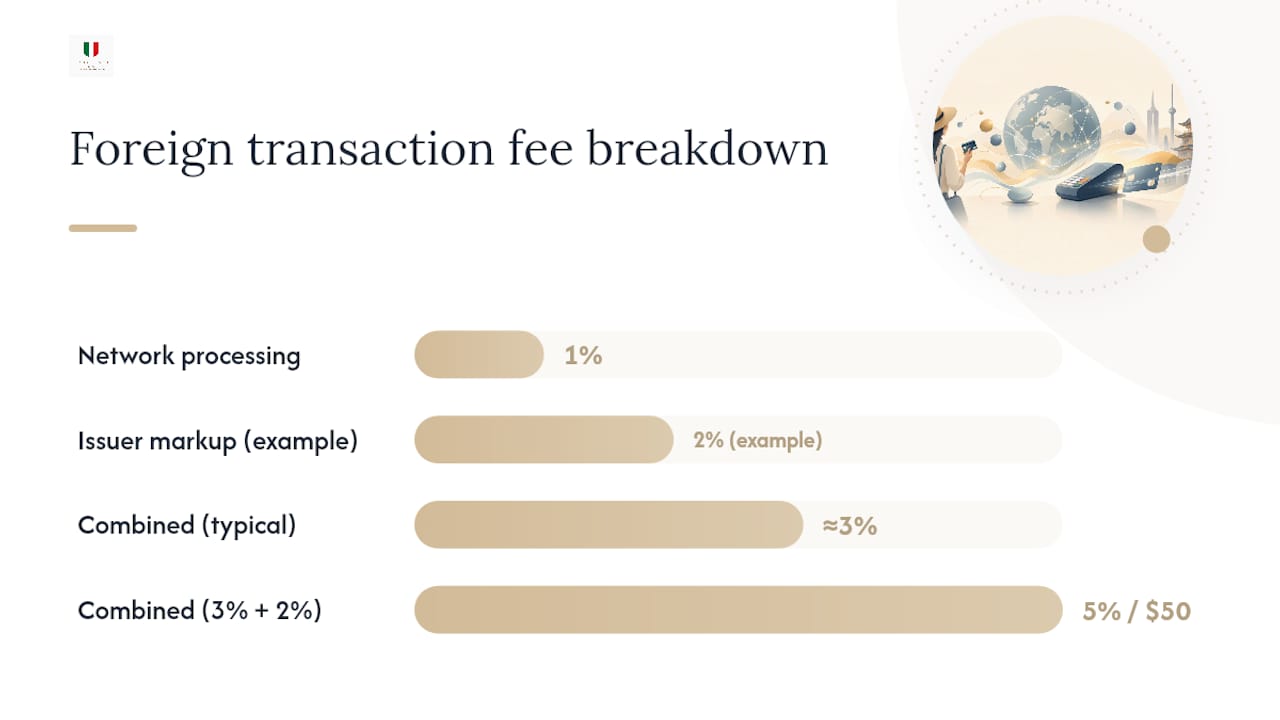
Look for it on your statement as a line labeled “foreign transaction fee,” “international transaction fee,” or sometimes folded silently into the posted dollar amount. Here’s where it stings: if your card carries a 3% foreign transaction fee and your issuer also applies a 2% conversion markup, a $1,000 purchase costs you roughly $50 in combined charges before you’ve bought anything.
Dynamic currency conversion, often called DCC or cardholder preferred currency, is when a merchant terminal or ATM offers to convert your purchase into your home currency right at the point of sale, instead of leaving that job to your card issuer. It sounds like a convenience. It’s almost always a trap.
A third-party DCC provider, not your bank, sets that exchange rate, and the markup can run as high as 18% in the worst cases, layered on top of whatever foreign transaction fee your card already charges. You end up paying twice for the same conversion: once to the DCC operator’s inflated rate, once to your issuer’s surcharge if it still applies.
Here’s how to handle the prompt when it appears:
Pro Tip: ATMs default to DCC more often than card terminals do. When the screen asks “Would you like to be charged in U.S. dollars?” the answer is almost always no. One consumer-facing DCC explainer from Wise recommends always choosing the local currency and double checking the on-screen rate before confirming, since declining DCC and letting your own card issuer convert the charge is nearly always the cheaper path.
The gap between the best and worst options on the same transaction is larger than most people expect. Card network processing typically runs around 1%. DCC markups are the wildcard, often the most expensive layer of all.
Specialist transfer services tend to price closest to the real rate, often adding only about 0.4% to 0.6% over mid-market.
Run the math on a $5,000 conversion. On a smaller $300 purchase, those same markups cost roughly $1.50, $9, and $30, respectively. The percentage stays constant. The dollar loss scales with the size of the purchase, which matters a great deal when you’re paying for a designer handbag rather than a coffee.
Cutting these costs down to near zero takes about five minutes of setup before you travel or buy internationally. Here’s the priority order that actually moves the needle.
Pro Tip: Keep a note of the mid-market rate on your phone before a big international purchase. Comparing it against whatever rate a merchant or bank offers takes thirty seconds and can save you real money on a five-figure transaction.
This matters more in some markets than others. Consumers inside the European Union benefit from rules requiring providers to disclose total conversion charges as a percentage markup over the European Central Bank’s reference rate before you finalize payment, making it far easier to compare providers head to head. Outside the EU, that disclosure obligation often doesn’t exist, so the burden falls on you to check the rate yourself. A comparison of bank and exchange kiosk rates is a useful habit to build before any major cross-border payment, regardless of where you’re located.
Buying a designer bag or a pair of Italian-made shoes from an overseas retailer runs a slightly different fee gauntlet than swiping a card at a café abroad. The conversion can happen at two separate points: once at checkout, if the merchant’s site prices in a foreign currency and offers to convert it for you, and again on your card statement, if your issuer applies its own rate and surcharge on top.
Before you check out on any international fashion retailer, run through this short list:
Urbalenti NYC includes U.S. import duties and taxes in its stated pricing rather than surprising buyers with them at delivery, which removes one entire layer of cross-border cost guesswork from the equation. For a deeper look at how landed cost actually breaks down on a real purchase, see worked examples of cross-border designer purchases and a closer breakdown of what U.S. buyers actually pay in customs fees from Italy.
Currency and duty surprises hurt worst on the transactions where they should matter least. The same markup on a $3,000 handbag is real money, and it compounds with any duty or tax that also gets tacked on after the fact. Clear, upfront pricing on cross-border purchases isn’t a courtesy. It’s the difference between knowing what you’re actually spending and finding out later.
Before buying anything internationally, especially at luxury price points, add up the full landed cost: item price, plus duties, plus whatever conversion markup applies to your payment method. That total, not the sticker price, is the number that matters.
— Admin Urbalenti™ NYC
The pricing includes U.S. import duties and taxes, and worldwide shipping is offered, so the number you see at checkout reflects what you pay without unexpected customs bills later.

That kind of predictability matters most on the purchases where currency markups do the most damage: designer bags, shoes, and ready-to-wear priced well into four figures. Browse the Designer Fashion from Italy collection to see current pieces sourced directly from Italian boutiques, or go straight to a specific find, like the Balmain Black Lamb Leather Handbag, the Tod’s Black Calfskin Tote Bag, or the Dolce & Gabbana Silver Calfskin Low Top Sneakers. Shoppers building out a full look might also look at the Dolce & Gabbana Black Calfskin Stiletto Heel Sandals, the Dolce & Gabbana Bicolor Calfskin Sneakers, the Dolce & Gabbana Multicolor Silk Flared Pants, a Fendi Brown Polyester Other Accessories piece, or the Max Mara Multicolor Virgin Wool Casual Pants. Check the current collection now and see the full landed price before you commit to checkout.
It depends entirely on who’s converting your money. Specialist providers often add only about 0.4% to 0.6% over the mid-market rate, while banks and payment platforms typically charge 1% to 3%, and airport kiosks can run 5% to 12% or more on the same transaction.
Pay in the local currency whenever you’re given the choice, and always decline dynamic currency conversion at card terminals and ATMs. Pair that habit with a credit card that charges no foreign transaction fee, and use a low-markup transfer service for larger purchases or wires.
Currency conversion costs are the combination of the exchange-rate markup a bank or processor adds plus any separate foreign transaction fee your card issuer charges. Foreign transaction fees alone typically fall between 1% and 3%, and the conversion markup stacks on top of that.
Yes, in almost every case, unless you’re using a specialist provider that discloses a near mid-market rate with a small transparent fee. Banks, card networks, PayPal, and exchange kiosks all build a markup into the exchange rate itself, even when they don’t label it as a separate charge.
No. The pricing for U.S. orders includes import duties and taxes, so buyers see the full landed cost upfront rather than facing a separate customs bill after delivery.
Editorial Note: Product availability, pricing, and shipping conditions may change. All products featured by URBALENTI™ NYC are 100% authentic and original. Please refer to the applicable product page and store policies for current details.
Leave a comment