
MY WISHLIST
MY WISHLIST

Buy an all-risk policy or a reputable third-party flat-rate Shipping Insurance for Luxury Retailers at checkout for any international parcel carrying real value. Carrier liability is typically limited to a low default amount per shipment, while third-party coverage typically runs 1% to 1.5% of declared value. For a $2,000 handbag or a $10,000 wholesale order, that gap between what a carrier owes you and what you actually lose is the whole argument. Add coverage at label purchase or through a checkout API before the box leaves the warehouse.
TL;DR:
Urbalenti NYC
Shop Authentic Designer Fashion
Explore curated bags, shoes, and apparel from renowned Italian brands, with transparent duties for U.S. orders and worldwide shipping included.
International shipping insurance is a policy you or your seller buys to cover the declared value of goods in transit, separate from anything a carrier automatically owes you. Carrier liability is not insurance. It is a contractual cap, often around $100 per package unless you pay for additional declared value, and it exists to limit the carrier’s exposure, not to make you whole after a loss.
Insurable interest is the legal requirement that you must actually stand to lose money if the shipment is damaged or lost before you can insure it. This matters more than most sellers realize, because it ties directly to Incoterms, the standardized shipping terms that define who owns the risk at each stage of a shipment.
Two coverage structures dominate the market:
Under Incoterms like FOB, the buyer assumes risk once goods pass the ship’s rail, meaning the buyer, not the seller, needs to hold the insurable interest at that point. Under CIF or CIP, the seller is obligated to arrange insurance on the buyer’s behalf. Get this wrong and you can end up with a cargo leg that nobody insured.
Most international cargo and parcel policies cover physical loss, theft, and damage during transit, plus general average, the maritime principle where all cargo owners share losses when goods are sacrificed to save a vessel. That is the coverage side. The exclusion side is where most disputes happen.
Common exclusions that trip up claimants include:
Carriers and cargo insurers like MSC publish these exclusions directly on their policy pages, along with the documentation and survey steps required to process a claim. The practical takeaway: photograph packaging before sealing it, keep the original packing materials if damage is discovered, and never discard evidence before an insurer’s surveyor has a chance to inspect it. Denied claims are disproportionately tied to weak documentation, not fraud or bad luck.
Pricing splits into two clear models: flat percentage rates from third-party insurers, and tiered add-ons sold by the carriers themselves. Third-party providers tend to win on both price and simplicity.
EasyPost advertises parcel insurance at a flat 1% of declared value, a rate structure that scales predictably regardless of shipment size. Easyship prices its international parcel protection starting around a low percentage of value, with coverage available up to a capped amount per shipment. Carrier-provided add-ons vary more widely and often carry minimum charges that make them inefficient for lower-value goods.
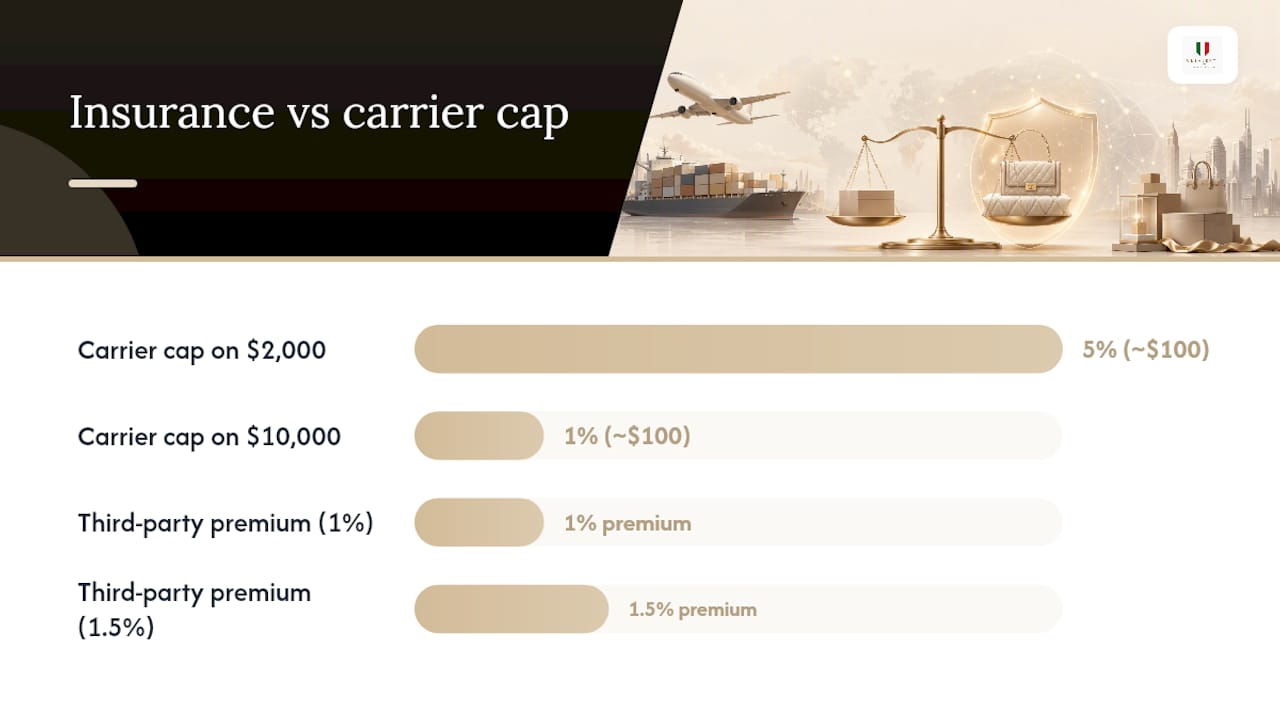
Statistic to remember: carriers commonly cap default liability around $100 per shipment, regardless of what the contents are actually worth, unless you declare additional value or buy separate coverage through the Easyship insurance API.
Here is how that plays out on two realistic shipments:
| Shipment value Carrier default liability Third-party premium at 1% Third-party premium at 1.5% | |||
| $2,000 | ~$100 | $20 | $30 |
| $10,000 | ~$100 | $100 | $150 |
On the $10,000 example, a $100 to $150 premium protects against a $9,900 uninsured loss under carrier terms alone. That math rarely favors skipping coverage, especially for anything leaving the country. Some consumer-facing platforms, including Eurosender, bundle a small default coverage amount (often capped near €200) automatically and sell incremental increases for higher values, which is worth checking before assuming a shipment has zero protection.
The right product depends on shipment type, frequency, and value, not just cost per shipment.
Subrogation, the insurer’s right to recover its payout from a negligent third party after settling your claim, matters more with cargo policies than parcel insurance, since freight moves through more hands and more jurisdictions.
Pro Tip: Primary insurance, which pays out first regardless of what a carrier owes, settles faster than contingent insurance that only activates after carrier liability is exhausted. If you ship frequently, ask specifically whether a policy is primary or contingent before buying.
If you are shipping five or more high-value cross-border parcels a week, an annual cargo program almost always beats stacking individual parcel policies on cost and claims speed.
Claims that stall almost always trace back to a missing document or evidence that was thrown away before anyone photographed it.
Insurance earns its premium fastest on shipments that are expensive, fragile, traveling long distances, or heading into a market you have not shipped to before. A $150 premium on a $10,000 shipment is a rounding error against the loss it prevents.
A single uninsured loss on a luxury handbag or a pair of designer sneakers can wipe out the margin from several successful shipments combined.
Pro Tip: Declared value should match your actual sale price or replacement cost, not a rounded-down estimate meant to save a few dollars on premium. Insurers reduce payouts to match understated declared values, and that gap comes out of your pocket, not theirs.
Retailers building checkout flows on platforms with strong extension support, including setups guided by resources like BigCommerce SEO Automation, have an easier time surfacing insurance offers at the moment a customer is already deciding to buy.
Urbalenti NYC fulfills orders directly from Italy, and every shipment carries U.S. import duties and taxes included for domestic orders and EU VAT included where applicable, so customers are never surprised by a bill after the box arrives. High-value pieces are packed with care and documentation intended to support claims if issues arise in transit, including original packaging, protective inserts, and photographic records before dispatch.
Customers may contact support to inquire about insurance options for their orders before checkout, especially for higher-value items. Specialized packaging is used to consider how fragile or high-value pieces are shipped.
Start with replacement cost, not resale value. A designer handbag or a pair of limited-run sneakers can be difficult or impossible to replace at the original price if a similar piece has since sold out or increased in price, so insure to the cost of sourcing an equivalent replacement today, not what you originally paid.
Layer in transit risk by mode and route. Air freight generally carries lower handling risk than ocean freight but shorter claim windows; multimodal shipments (truck to air to truck) introduce more handoff points where damage or loss tends to occur. A shipment crossing three customs zones carries more risk than one crossing one, simply because more people and more systems touch it.
Frequency changes the math too. A business shipping high-value goods internationally every week benefits from calculating an annual loss exposure figure (total declared value shipped times a realistic loss rate) and comparing that against the cost of an open cargo policy versus per-shipment parcel insurance. Individual buyers making a single purchase do not need this level of modeling. A straightforward comparison between the item’s declared value and the insurer’s premium is usually enough to decide.
Fragility and category matter as much as price. A $500 pair of leather sneakers is lower risk than a $500 item with delicate embellishment or hardware, even at the same declared value, because the physical failure modes differ.
The most common fraud pattern is the fake or lookalike insurance offer at checkout, often mimicking a legitimate carrier or platform brand but routing payment to an unrelated third party with no real claims process behind it. If an insurance option appears at checkout with no policy number, no insurer name, and no link to actual policy wording, treat it as a red flag.
Another recurring scam targets sellers directly: a buyer claims a package arrived empty or severely damaged, but provides only a written description with no photos, no retained packaging, and pressure to refund immediately before any investigation. Insurers and carriers require photographic and physical evidence precisely because this pattern is common, so a legitimate claims process will never ask you to skip that step.

Watch for policies that are unusually cheap relative to the market rate mentioned earlier (roughly 1% to 1.5% of declared value from established third-party insurers). A rate far below that, paired with vague terms and no clear underwriter, is a signal to verify the insurer’s identity before paying. Cross-check any unfamiliar insurer against the carrier or platform’s own listed partners before trusting it with a high-value shipment.
International shipping insurance intersects with customs valuation, sanctions compliance, and the insurance regulations of whichever country underwrites the policy. Declared value for insurance purposes should align with the value declared for customs, since a mismatch between the two can complicate both a customs audit and an insurance claim.
Sanctions and export control exclusions are standard across nearly every cargo and parcel policy, meaning coverage will not apply if a shipment violates trade restrictions between the origin and destination countries, regardless of how the loss occurred. This is a separate issue from general war exclusions and applies even on routine commercial shipments if either country involved is subject to specific restrictions.
Insurers underwriting cross-border cargo are themselves regulated in their home jurisdiction, and policy wording, not marketing copy, governs what a claim actually pays. Read the policy document itself, particularly the valuation clause and the exclusions section, rather than relying on a summary from a carrier’s marketing page. For sellers operating internationally, keeping records that satisfy both customs and insurance documentation requirements in one system avoids duplicating paperwork if a claim and a customs question arise on the same shipment.
Luxury buyers do not distrust shipping insurance because the products are unreliable. They distrust it because so few retailers explain what is actually covered before something goes wrong. A checkout page that names the coverage tier, the claims process, and the timeline builds more buyer confidence than any discount ever will. Retailers still treating insurance as a hidden upsell rather than a stated feature are leaving trust on the table. Testing API-based insurance integration at checkout, rather than bolting it on after the fact, is the single highest-leverage change most sellers of high-value goods haven’t made yet.
— Admin Urbalenti™ NYC
Urbalenti NYC ships every order direct from Italy with U.S. import duties and taxes included and EU VAT included, so the price you see at checkout is the price you pay, with no surprise charges when the package clears customs. That transparency extends to how pieces are packed and documented, giving customers a clear paper trail if a claim ever becomes necessary.

If you are eyeing a piece like the Dolce & Gabbana Blue Cotton Handbag or a pair of Dolce & Gabbana Bicolor Calfskin Sneakers, browse the current Designer Fashion from Italy collection and reach out to support before checkout if you want to confirm coverage details on a high-value order. Getting the packing, valuation, and shipping details right before the box leaves the warehouse is the best insurance any purchase can have.
UPS and other carriers price declared-value coverage in tiers, and costs vary by service level and destination, so there is no single published rate for a $10,000 shipment. A comparable third-party policy at EasyPost’s flat 1% rate would run about $100 for the same value, which is a useful benchmark when comparing carrier quotes.
FedEx calculates declared-value charges based on the shipment’s value and service type rather than a single flat percentage, so the exact figure depends on the specific shipment details. For comparison, a third-party insurer pricing at 1% to 1.5% would charge a low percentage of the declared value, giving you a rough ceiling to check carrier quotes against.
USPS insurance pricing is tiered by declared value bracket rather than a flat percentage, so the exact cost varies depending on shipment value.
At a flat 1% rate, insuring a $2,000 shipment costs about $20. At the 1.5% rate some platforms charge, such as Easyship’s international parcel protection, the same shipment would cost around $30, still far below the gap between carrier liability limits and the actual shipment value.
Urbalenti NYC ships every order from Italy with U.S. import duties and taxes included and EU VAT included, and packs high-value pieces with documentation that supports a claim if damage occurs in transit. Customers who want to discuss added coverage on a specific high-value item should contact support before completing checkout.
All-risk coverage, often labeled ICC A, insures against any cause of loss that is not specifically excluded, making it the broadest protection available for international cargo. Named-peril, or limited liability, coverage only pays for losses caused by perils explicitly listed in the policy, leaving many real-world damage scenarios uncovered.
Editorial Note: Product availability, pricing, and shipping conditions may change. All products featured by URBALENTI™ NYC are 100% authentic and original. Please refer to the applicable product page and store policies for current details.
Leave a comment