
MY WISHLIST
MY WISHLIST

Last Updated: November 1, 2026
Quick Summary
Third party luxury authentication is an independent company's expert opinion on whether an item is genuine, while brand verification is the original fashion house confirming the item came from its own production. Independent authenticators are accessible and fast but give an opinion, whereas brands hold definitive records yet rarely share them with secondhand buyers.
Third party luxury authentication is the process of having an independent company assess whether an item is genuine, while brand verification is the original fashion house confirming that a specific item came from its own production. The distinction matters because the two services answer different questions, carry different evidence standards, and are not equally available to ordinary shoppers. At URBALENTI, we source through established European networks, so we follow this debate closely. Below, we break down what each route actually proves, where each one falls short, and how to choose between them before you spend on a designer handbag or a pair of shoes.
The core tension is simple: independent authenticators are accessible and fast, but they are giving an opinion. Brands hold the definitive records, but most of them will not share those records with consumers. Understanding that gap is the whole game.
A third-party authentication service examines an item and issues a judgment on its legitimacy, usually without any access to the brand's internal records. The typical process runs through a few stages:
The best authenticators specialize by category, since a handbag specialist reads leather grain and hardware weight differently than a sneaker specialist reads sole tooling.
Brand authentication policy varies widely, and that variation is the single biggest reason shoppers end up confused. A luxury house may confirm authenticity internally for its own warranty or repair work, yet decline to issue a written statement to a consumer who bought the item secondhand. Some brands will inspect an item at a boutique; many will not, and policies change without notice.
The practical consequence is that brand verification is often unavailable exactly when you need it most: during a resale or consignment purchase. When a brand does weigh in, its confirmation carries real weight because it comes from the maker's own records. When it stays silent, no amount of asking will produce a document. Treat any promise of "brand verification" from a seller with suspicion unless the brand itself is the one confirming.
Learning how to authenticate designer items means learning to read the physical evidence an item carries. No single check is conclusive, so authentication is cumulative: several small confirmations together build a reliable picture.
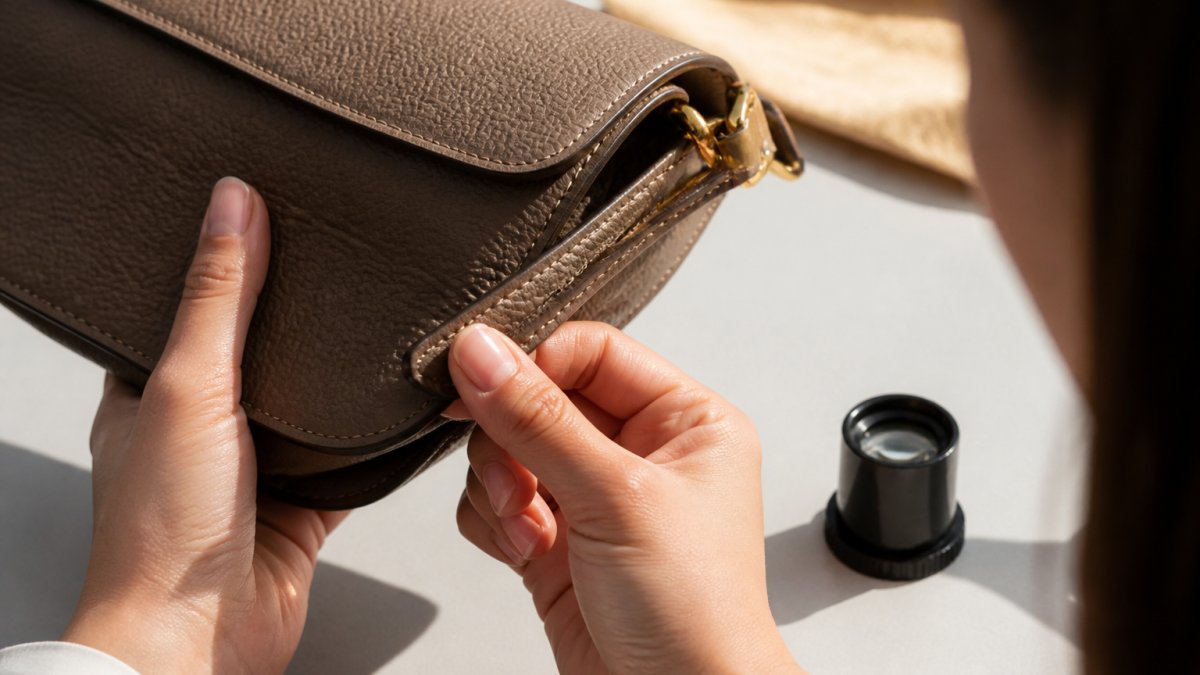
The methods that matter most:
For a deeper walkthrough of these checks, our guide on how to verify authentic designer clothing breaks the process into practical steps you can follow at home. Documentation and provenance help too, but paperwork is the easiest thing to fake, so weigh the physical examination more heavily than a folder of receipts.
An authentication certificate for designer bags proves that one authenticator, on one day, formed the opinion that the item was genuine. It does not prove the item is genuine beyond dispute, and it does not carry the brand's authority. That is a meaningful distinction, not a technicality, and it is where most buyers get into trouble.
A credible report is more than a one-line verdict. Most established authenticators issue a document that includes:
A certificate that omits the scope and limitations is a red flag. The value of the document sits in the reasoning, not the seal.
The evidentiary weight of a certificate depends heavily on how the item was examined. A photo-based review is fast and accessible, but it is limited to what the camera captures: lighting, angle, and compression can hide or distort the very details that matter. An in-person inspection allows the authenticator to weigh hardware, feel leather grain, examine interior seams, and check for signs of re-stitching or replacement parts that photographs rarely reveal.
For a lower-value item, a photo review is often proportionate. For a high-value handbag, an in-person inspection generally produces a stronger document.
In practice, an authentication report functions as a documented second opinion. It can support a resale listing, strengthen a marketplace dispute, satisfy an insurer's questions about a high-value item, or give a buyer confidence before a private sale. What it cannot do is substitute for the maker's own confirmation, which, as the next sections explain, is rarely available to consumers anyway. Treat the certificate as one piece of evidence in a file, not as a final word.
Reliability, cost, and turnaround time pull in different directions, and the right choice depends on what you are buying and why. Independent authentication is generally faster and more accessible; brand verification is more authoritative but rarely offered to consumers. Neither is free of trade-offs, and the trade-offs are more concrete than most guides admit.
| Factor | Third Party Authentication | Brand Verification |
|---|---|---|
| Availability | Widely available to consumers; photo review can be requested same-day | Limited; often unavailable to secondhand buyers, and policies change without notice |
| Evidence base | Expert comparison against reference libraries and handled inventory | Maker's own production records, materials, and internal documentation |
| Speed | Turnaround depends on the service; in-person inspection generally takes longer | Depends entirely on brand policy; may require an in-store visit or repair intake |
| Authority | Opinion of an expert firm; weight depends on reputation and category specialty | Confirmation from the maker; strongest possible evidence when obtained |
| Cost | Varies by service, category, and review type; photo reviews are typically the lower-cost option | Often none offered, or bundled with a paid service such as repair or warranty work |
| Best for | Resale, pre-owned, consignment, and private-sale purchases | Warranty, repair, and boutique purchases where the brand is already involved |
Reliability in third-party authentication is not a single number. It is a function of three things: the authenticator's category specialty, the size and quality of its reference library, and the scope of the review. A handbag specialist who has handled thousands of a given model reads leather grain and hardware weight differently than a generalist working from photographs. A photo review of four images is not equivalent to an in-person inspection of the same item.
When comparing services, ask what the review covers and who performs it, not just what it costs.
Speed and depth are in tension. A photo-based review can be completed quickly because it relies on submitted images; an in-person inspection takes longer because the item must be received, examined, and documented. For a time-sensitive resale purchase, the photo review may be the only realistic option, but budget for the possibility that the in-person inspection would have caught something the photos did not.
Brand verification is more authoritative in principle because it draws on the maker's own records. In practice, most luxury houses do not offer authentication to consumers who bought secondhand, and policies vary widely and change without notice. When a brand does weigh in, often through warranty or repair intake, its confirmation carries real weight. When it stays silent, no amount of asking will produce a document. That asymmetry is the single biggest reason third-party authentication is the realistic option for most purchases.
For handbags specifically, our breakdown of how to spot fake luxury handbags covers the categories counterfeiters target most, and the methods section above explains the physical checks that underpin any credible review.
Disputes are where the difference between the two routes becomes concrete. If a seller misrepresents an item, your case rests on evidence, and the standard you can meet depends on what you gathered before and after the purchase.
A third-party authentication report is useful evidence in a dispute, but it is an opinion, and a determined seller can dispute it with another opinion. Brand confirmation, when you can get it, is stronger, but it is rarely obtainable. The practical lesson is to build your evidence file early: keep the listing, the seller's claims, your payment records, and any authentication report together. The best protection, though, is avoiding the dispute altogether, which is why our guide on avoiding counterfeit luxury fashion online is worth reading before you buy from an unfamiliar source.
Choosing between the two comes down to your purchase context, not to which service sounds more official. Use this decision framework:
The rule of thumb we would give a friend: use third-party authentication to decide whether to buy, and treat brand verification as a bonus you cannot count on.
The strongest authentication strategy is buying from a source that has already done the work.
That is the model we built URBALENTI around. Items are brand-new, sourced through established European networks, and shipped from Italy, with a strict policy against counterfeit, replica, or imitation goods. For shoppers weighing their options, our guide to verified luxury online retailers to trust and our broader look at where to buy authentic designer goods both lay out what to check before you commit. For U.S. customers, free shipping is available with no minimum purchase, import duties are included in the price, and a free exchange option is available.
Third-party luxury authentication is an independent assessment by a specialist who examines materials, stitching, hardware, and markings to judge whether an item is genuine. Brand verification is a statement from the original fashion house itself. The key difference is who provides the judgment: an outside expert or the brand. Independent authentication is generally more available to consumers, while brand verification is limited because most luxury houses do not offer it as a consumer service. Each answers a different question and carries different weight in a dispute.
Most luxury brands do not provide authentication as a consumer service, and their brand authentication policy often limits staff to confirming whether an item was made by them without issuing written documentation. Some houses will inspect an item during a repair request, but that is not the same as a formal verification. Policies vary widely by brand, so ask the specific house directly. If a brand will not verify an item, an independent luxury authentication service is the practical alternative for a documented opinion.
No certificate guarantees authenticity. An authentication certificate for designer bags records an expert opinion based on the evidence available at the time, such as photos or a physical examination. It does not prove provenance or override a brand's own records. Treat the certificate as one strong piece of evidence, not a warranty. Reputable authenticators state their scope and limitations clearly, and a certificate is most useful when combined with a seller's return policy and clear documentation.
Buy from sellers who are transparent about sourcing and offer a clear return policy. Ask for detailed photos of stitching, hardware, logos, and serial numbers before purchase, and compare them against known examples. For higher-value pieces, commission a third-party authentication review before or immediately after buying. Keep all documentation, including receipts and the authentication report, in case a dispute arises. Choosing a retailer with a strict anti-counterfeit policy and included duties, like URBALENTI, can simplify that process.
The real challenge is not learning to authenticate after the fact; it is finding a source you do not have to second-guess. That is where we come in. URBALENTI offers a curated selection of authentic designer fashion sourced through established European networks, a strict anti-counterfeit policy, and transparent pricing with duties included. Get started with URBALENTI and shop designer pieces with the confidence that authenticity has already been handled.

Leave a comment