
MY WISHLIST
MY WISHLIST

Most men need one of four jacket types: a versatile 600 to 700 fill mid-layer for daily cold, an ultralight 800-plus fill piece for backpacking, a heavy 700 fill/high fill-weight parka for sub-zero conditions, or a treated hybrid for wet climates. Budget jackets fill a fifth niche when fit and warmth matter more than pack size. The right pick depends entirely on your climate and how you’ll actually wear it.
TL;DR:
- For most men, a 650 to 750 fill power down jacket offers the best balance between warmth, durability, and price for daily use.
- Ultralight jackets with 800-plus fill power are ideal for packing light on backpacking trips but sacrifice some durability and interior space.
- Jackets designed for extreme cold rely on high fill weight, box-baffle construction, and longer cuts to deliver warmth in sub-zero temperatures.
- Budget options typically feature lower fill power and simpler construction, suitable for moderate city wear but less effective in harsh conditions.
- Always compare fill power and fill weight together, check shell denier for durability, and verify down sourcing certificates before purchasing.
Skip the spec-sheet paralysis. Here’s the fast version, broken down by what you’re actually trying to do outside.
Best overall. For most men who split time between commuting, weekend hikes, and casual cold, a jacket in the 650 to 750 fill-power range with a moderate fill weight hits the sweet spot. It’s warm enough for most conditions without the fragility or price tag of ultralight gear. Expect a mid-length cut, a couple of hand pockets, and a shell that can survive a subway commute and a trailhead parking lot.
Best ultralight. If you’re chasing pack weight, look for jackets built around 800 fill power or higher. Higher fill power means less down mass is needed to trap the same warmth, which is why independent bench testing treats fill power and fill weight as combined metrics rather than judging fill power alone. You’ll trade some durability and interior pocket space for a jacket that disappears into a backpack.
Best extreme cold. Standalone warmth for single-digit temperatures and below calls for high fill weight, not just high fill power. A jacket stuffed with a large quantity of even 700 fill down will often out-warm a sparse 900 fill piece. Look for box-baffle construction, an insulated hood, and a longer cut that provides good coverage.
Best budget. Realistic compromises here mean 600 to 650 fill power, a straightforward sewn-through baffle instead of box-wall construction, and a simpler hood. You give up some warmth-to-weight efficiency, but a well-made budget jacket still performs fine for city winters and moderate outdoor use.
Best water-tolerant hybrid. Hybrid and treated-synthetic builds exist because pure down loses loft when saturated. Testing from outdoor gear reviewers shows synthetic and hybrid insulation now competes directly with down in wet, high-output activities, even though down still wins on pure warmth-to-weight in dry cold. Choose a hybrid if you live in a damp climate or sweat heavily during activity.
Fill power and fill weight get thrown around like they’re interchangeable. They’re not, and confusing them is the single most common reason men end up cold in a jacket they thought would be plenty warm.
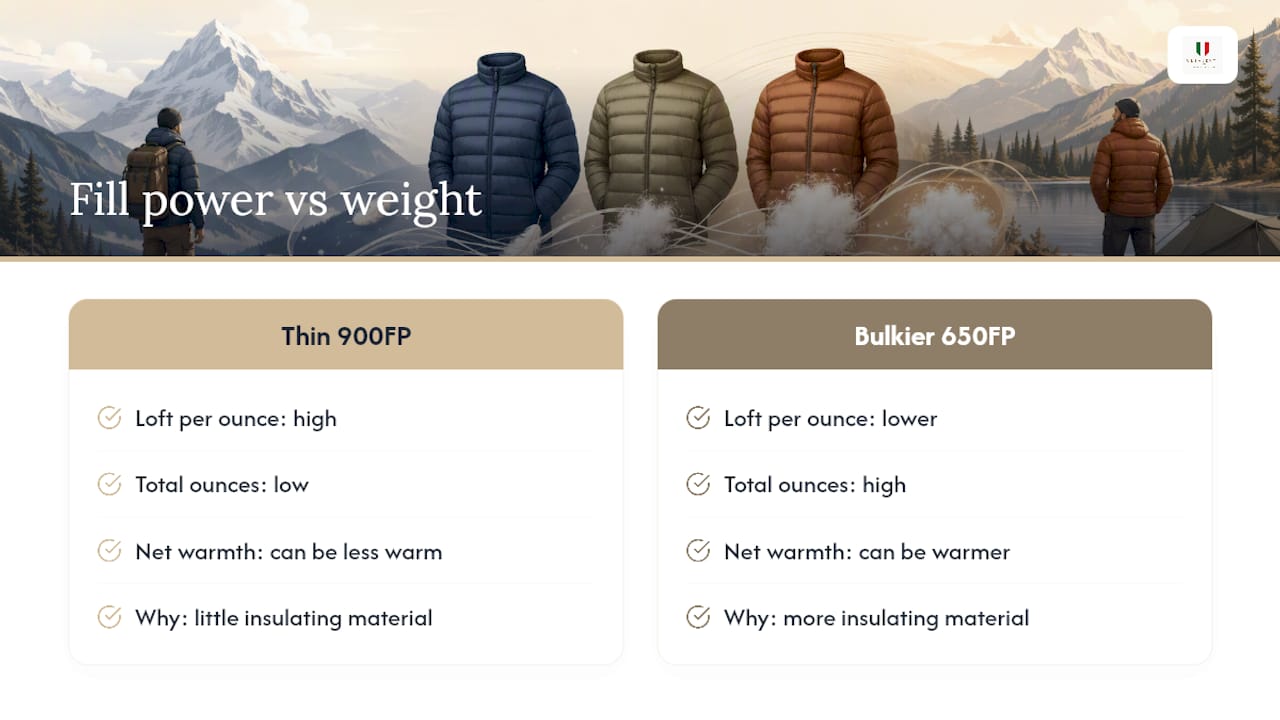
Fill power measures the loft, or fluffiness, of one ounce of down: how much space it fills when it expands. An 800 fill-power jacket traps more air per ounce than a 550 fill-power jacket, which is why higher numbers get marketed as “better.” But fill power alone doesn’t tell you how warm a jacket will actually feel on your body. That comes down to fill weight, the total ounces of down stuffed into the garment. A thin jacket loaded with 900 fill power down can still be less warm than a bulkier jacket packed with a larger quantity of 650 fill down, because there’s simply more insulating material in the second one.
The reliable shortcut, backed by comparative down jacket testing, is to multiply fill power by fill weight rather than looking at either number in isolation. It’s a rough metric, not a lab-certified formula, but it beats reading a “800 fill power!” label on the hang tag and assuming that settles the warmth question.
This is the workhorse category, and it’s where most men should start. Expect fill power in the 650 to 750 range, moderate fill weight, and a nylon or polyester shell somewhere between 20 and 40 denier. That denier range matters more than it sounds: too thin, and the shell abrades against backpack straps or car doors; too thick, and you lose the packability that makes down appealing in the first place. These jackets usually run a slightly boxier cut that layers fine over a sweater, with two or three exterior pockets and sometimes an interior stash pocket for a phone.
Ultralight construction accepts real trade-offs. Field-test patterns across multiple reviewers show that ultralight jackets consistently sacrifice abrasion resistance and interior pocket space for weight savings, using shell fabrics as light as 10 to 15 denier and smaller baffle spacing to keep down evenly distributed without adding fabric weight. That thinner shell is genuinely more prone to snagging on branches, gear straps, or a rough rock face. If you’re a thru-hiker counting ounces, that trade is worth it. If you’re wearing the jacket around town three days a week, it won’t hold up nearly as long as a slightly heavier build.
Here, fill weight does the heavy lifting. A parka rated for sub-freezing standalone use typically carries a large total down mass, often paired with fill power in the 700 to 850 range rather than chasing the highest number available. Box-baffle construction, where fabric walls separate down chambers into distinct compartments, prevents the down from shifting and creating cold spots, which is a common failure point in cheaper sewn-through designs. These jackets run longer in the torso, often past the hip, and usually include a insulated, adjustable hood built to work without a helmet underneath.
Budget doesn’t have to mean poorly made. It usually means a simpler construction method: sewn-through baffles instead of box-wall, a slightly lower fill power in the 600 to 650 range, and fewer premium extras like a helmet-compatible hood or laminated seams. For daily city wear and moderate outdoor use, that’s an entirely reasonable set of compromises. Where budget jackets tend to fall short is in wind resistance and long-term loft retention. If the description doesn’t mention shell treatment at all, assume it has none.
Hybrids combine down insulation with synthetic panels in high-moisture zones like shoulders and cuffs, or use hydrophobic-treated down throughout. Nikwax’s technical guidance is direct on the limits here: hydrophobic treatments meaningfully improve moisture resistance and help treated down retain loft longer than untreated down in damp conditions, but the result is water-resistant, not waterproof. A saturated outer shell will still collapse the insulation’s loft eventually, treated or not. Hybrids make the most sense for men in the Pacific Northwest, coastal climates, or anyone who sweats heavily during high-output activity.
Pro Tip: Don’t buy on fill power alone. Ask for both fill power and fill weight (sometimes listed as “down fill” in grams or ounces) and multiply them. That single calculation tells you more about real-world warmth than any marketing copy on the product page.
As a rough decision rule: go 800-plus fill for anything where pack size is the priority, aim for high fill weight over high fill power for extreme cold standalone use, and treat 650 to 750 fill as the default for everything in between.
Product pages love to bury the numbers that actually matter under lifestyle photography. Here’s what to pull out and compare side by side.
Fill power and fill weight, always together. As covered above, fill power tells you insulation efficiency per ounce; fill weight tells you total insulation. A listing that only mentions one of the two is giving you half the picture on purpose, usually because the missing number isn’t impressive.
Shell denier. Lower numbers (10 to 20 denier) mean lighter, more packable, and more fragile. Higher numbers (30 to 70 denier) mean heavier but tougher, better suited to daily wear and layering under a shell.
Baffle type. Box-baffle (or box-wall) construction keeps down evenly distributed and prevents cold spots, but adds weight and cost. Sewn-through baffles are lighter and cheaper but create seams where insulation is thinner, which shows up as a slight chill along the stitch lines in cold wind.
DWR coating or membrane. A durable water repellent (DWR) finish sheds light rain and snow. It is not a substitute for a hydrophobic-treated down fill or a genuine waterproof membrane, and it wears off over time with washing and abrasion.
Hood design. Fixed, insulated hoods trap more warmth. Packable or removable hoods add flexibility for layering under a helmet or hardshell but sacrifice some warmth at the collar.
Pockets and weight. Count hand pockets, interior stash pockets, and check the listed total garment weight, not just the fill weight. A heavy shell fabric can make a moderately insulated jacket weigh more than a well-built ultralight one.
Here’s a comparison framework worth keeping open in another tab while you shop:
| Criteria | Best For (Use Case) | Warmth-to-Weight | Weight / Packability | Weather Resistance | Fit / Layering |
|---|---|---|---|---|---|
| Everyday versatile | Commuting, casual outdoor | Moderate | Medium pack size | Basic DWR | Layers over a sweater |
| Ultralight technical | Backpacking, thru-hiking | High | Compresses to fist size | Minimal, thin shell | Slim, layers under a shell |
| Extreme-cold parka | Sub-freezing standalone use | High (via fill weight) | Bulky, not packable | Often treated down | Roomy, hood-compatible |
| Budget | Daily city wear | Lower | Medium, less compressible | Minimal | Standard, casual |
| Wet-weather hybrid | Damp climates, high-output activity | Moderate to high | Medium | Strong in damp conditions | Athletic to standard |
On pricing, value tends to concentrate in the mid-range. The jump from budget to mid-tier construction (box baffles, treated down, a real DWR finish) usually buys more durable warmth than the jump from mid-tier to flagship ultralight, where you’re mostly paying for grams saved, not degrees gained.
Here’s a detail most buyers skip entirely: ask where the down is sourced and whether it carries Responsible Down Standard certification. A listing that’s vague on sourcing but detailed on everything else is usually vague on purpose.
Red flags worth walking away from: no listed fill weight, no denier specification, a hood description that doesn’t mention adjustability, and reviews that consistently mention feather leakage after light use. That last one signals cheap baffle construction or a low-thread-count shell fabric that can’t contain down under stress.
Fit mistakes are the number one reason down jackets get returned, and it’s almost always because men buy for one context and wear the jacket in another.
Technical jackets, built for layering under a hardshell or over a base layer during high-output activity, run athletic through the body with articulated sleeves that don’t ride up when you raise your arms. Reviewer consensus draws a clear line here: technical cuts prioritize mobility and a close fit for layering, while lifestyle jackets favor a relaxed cut meant to sit comfortably over a sweater or flannel without a base layer underneath. Buying a technical cut for casual wear usually feels tight and restrictive; buying a lifestyle cut for backcountry layering usually leaves cold gaps at the wrists and waist.
If you’re planning to wear the jacket over a midlayer, size up one from your usual fit, particularly in the shoulders and chest. Sizing charts on most product pages assume a base layer only, not a fleece or wool sweater underneath. A jacket that fits perfectly over a t-shirt in the fitting room will feel noticeably tight once you add insulation layers on an actual cold morning.
Try-on checklist worth running through before you commit to a purchase:
Pro Tip: If you’re between sizes and plan to layer heavily, size up. A jacket that’s slightly loose still traps warm air effectively; one that’s slightly tight compresses the down and reduces its insulating loft exactly where you need it most.
For style-focused urban buyers eyeing a piece like the Moncler Beige Cotton Athletic Pants or another tailored outerwear pairing, the same rule applies in reverse: designer cuts often run closer to a lifestyle fit meant to be worn as a finished look, not stacked with bulky midlayers, so check the brand’s specific sizing notes rather than assuming standard outdoor-gear sizing logic carries over.
Down insulation dies from bad laundry habits more often than from actual wear. The good news is that proper care isn’t complicated once you know the sequence.
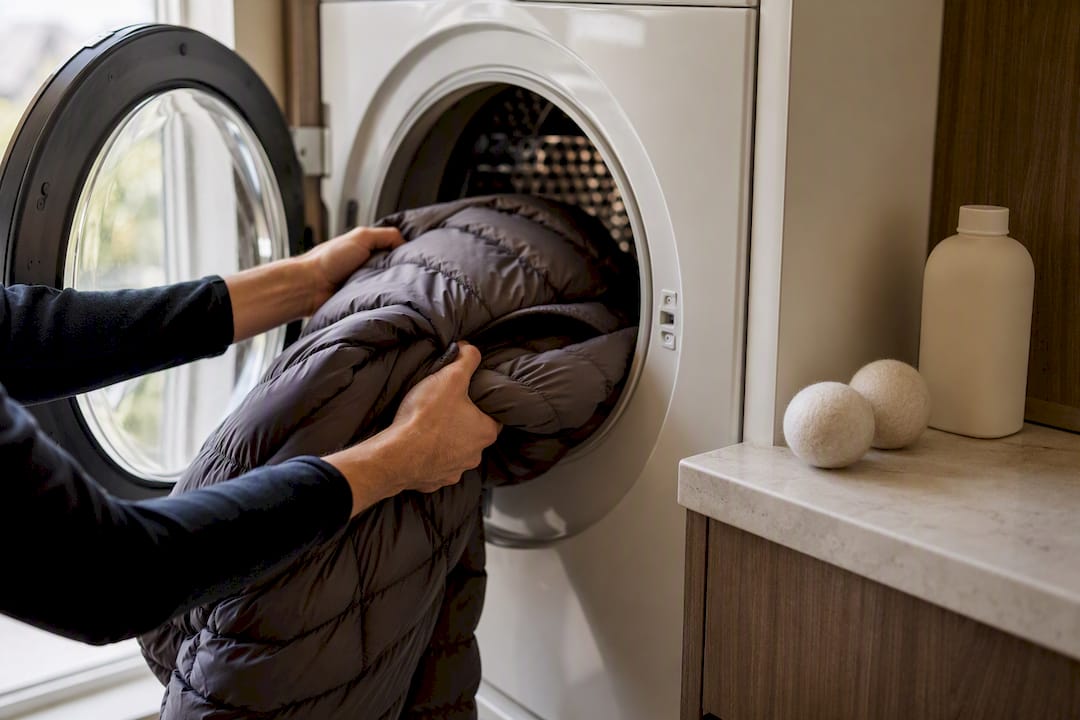
Machine wash on a gentle cycle using a down-specific detergent rather than standard laundry soap, which strips the natural oils that help down maintain its structure. Skip fabric softener entirely; it coats down clusters and flattens loft permanently. After washing, the drying stage is where most men go wrong: tumble dry on low heat and add two or three clean tennis balls or wool dryer balls to the drum. They physically break up clumped down as it dries, restoring loft that would otherwise stay matted.
Reapply a DWR treatment when water stops beading on the shell and instead soaks in visibly. This typically happens after several wash cycles or a season of regular wear. As covered earlier, hydrophobic-treated down retains loft longer in damp conditions than untreated down, but neither survives a fully soaked outer shell indefinitely, so refreshing the shell’s water resistance protects the insulation underneath just as much as the surface.
A little storage and repair basics worth building into habit:
Sustainability claims on outerwear tags range from meaningful to meaningless, and the gap between the two usually comes down to whether there’s a verifiable standard behind the label.
The Responsible Down Standard, maintained by Textile Exchange, certifies that down was sourced without live-plucking or force-feeding and provides traceability from the farm to the finished garment. That traceability piece is the part worth checking. A brand that states “RDS certified” without a certificate number or supply chain summary is making a claim that’s harder to verify than one that publishes its sourcing documentation.
Beyond RDS, look for bluesign-approved materials, which address chemical safety in dyeing and finishing processes, and PFAS-free DWR treatments, since older water-repellent chemistries relied on compounds now linked to environmental persistence. These aren’t yet universal standards the way RDS has become for down specifically, so treat them as supporting evidence rather than the sole basis for a purchase decision.
There’s a real trade-off worth naming honestly: RDS-certified down and PFAS-free finishes sometimes carry a price premium and, in some cases, a small performance trade-off compared to the cheapest treatment chemistries available. That’s a reasonable cost for verified sourcing, not a reason to skip certification altogether.
Questions worth asking a seller or checking on a product page before buying:
Most buying guides treat a down jacket purely as a performance object: fill power, fill weight, denier, done. That framework works fine for a thru-hiker. It works less well for the man who wants real cold-weather warmth but also wants to walk into a dinner reservation without looking like he just came off a trail.
That gap is where designer outerwear earns its place. A well-specified piece from a house that pairs technical down with a tailored silhouette and a finished shell fabric can deliver genuine insulation alongside a fit and provenance that mass-market technical brands rarely prioritize. The trade-off isn’t function versus style; it’s whether the brand bothered to specify real down fill and a durable shell underneath the design work. Some do. Many don’t say.
Urbalenti NYC curates its outerwear selection from Italian boutiques directly, which means the pieces carry documented provenance rather than secondhand sourcing guesses. Orders ship internationally with U.S. import duties and taxes included at checkout, and EU VAT included where applicable, so the price shown is the price paid, with free worldwide shipping and no surprise customs invoice weeks later.
If you’re shopping the designer side of this category, prioritize the same fundamentals covered earlier: check the fill type and shell material listed on the product page, not just the silhouette photos. A tailored down piece should still specify its insulation the same way a technical jacket does. Pair it thoughtfully; a fitted midlayer like the Y-3 padded hoodie works well under a slimmer designer shell without adding bulk that fights the tailoring.
— Admin Urbalenti™ NYC
Where technical brands optimize for grams and fill-power charts, Urbalenti NYC optimizes for the piece you’ll actually want to wear on a cold city night, sourced with the same rigor a serious buyer applies to fill weight and shell denier.

The current outerwear edit spans structured down jackets, quilted and padded silhouettes, and layering pieces suited to the kind of urban cold that doesn’t need alpine-grade insulation but does demand a jacket that looks intentional. A Mackage Victor R down jacket or a Stone Island 4100022 jacket both apply the fill-power and fill-weight logic covered throughout this guide, just wrapped in a shell built for the street rather than the summit.
Before you check out, run the same due diligence outlined earlier in this guide: measure yourself against the size chart rather than guessing from your usual off-the-rack fit, confirm the return window listed on the product page, and know that duties and EU VAT are already folded into the price you see, with free worldwide shipping on top. If you’re building out a full cold-weather look rather than a single piece, browse the Versace Bordeaux Silk Pattern Shirt as a layering base or start with the current outerwear collection directly.
For readers who want to go deeper than this guide’s buying framework, these sources cover the technical detail behind the claims made throughout the article:
No single brand holds a universal claim to highest quality; quality depends on fill power, fill weight, and construction matching your specific use case. Independent field and lab testing consistently rewards jackets that pair documented RDS-certified down with box-baffle construction over any single “best” brand claim.
There isn’t one best jacket across every use case; the best choice for a thru-hiker (ultralight, 800-plus fill) differs entirely from the best choice for sub-freezing standalone warmth (high fill weight) or urban daily wear (tailored fit with documented down sourcing). Match the category to your climate and activity first, then compare specific models within that category.
Fill power alone doesn’t determine total warmth; 800 fill down is more efficient per ounce, but a jacket with a higher fill weight of 700 fill down can be warmer overall than a lighter 800 fill jacket. Comparative testing recommends multiplying fill power by fill weight to compare real-world warmth accurately.
“Puffer jacket” is a general term describing the quilted, baffled look created by insulation compartments, while “down jacket” specifically refers to jackets insulated with natural down feathers rather than synthetic fill. A puffer can be insulated with down, synthetic fiber, or a hybrid of both, so the terms overlap but aren’t identical.
Editorial Note: Product availability, pricing, and shipping conditions may change. All products featured by URBALENTI™ NYC are 100% authentic and original. Please refer to the applicable product page and store policies for current details.
Leave a comment