
MY WISHLIST
MY WISHLIST

Last Updated: November 6, 2026
Quick Summary
Luxury craftsmanship is judged by stitch density, seam finishing, pattern alignment, and how a garment holds its shape, not by logos. In 2026, quiet luxury rewards buyers who verify fiber content, hardware weight, and provenance before paying for a name.
Luxury craftsmanship is the measurable difference between a garment that survives a decade of wear and one that loses its shape after a season.
The case for caring about construction has gotten stronger, not weaker. A Business of Fashion analysis of the luxury market makes the same point from the industry side: value increasingly sits in materials and make, not in visible branding.
Below, we break down a practical checklist: how to inspect a seam, compare cashmere to silk to leather, calculate cost-per-wear, and spot the red flags of a counterfeit. The payoff is simple.
Quiet luxury is not a trend cycle; it is a buying philosophy built on restraint, better materials, and designs that stay wearable for years. In 2026 it has settled into the mainstream of high-end fashion, and it has changed what shoppers reward.
Three shifts define the current landscape:
The practical consequence: quality standards now carry more weight than ever. When a piece has no logo to hide behind, every seam and fiber is on display. That is good news for anyone willing to learn what to look for, and it is the reason the rest of this guide focuses on inspection rather than brand hierarchy.
Spotting authentic luxury fashion comes down to three verifiable areas: the label and its serial markings, the hardware, and the consistency of construction throughout the piece. Counterfeits increasingly copy the look of a product while failing on the details that cost real money to produce.
Start with the label. On authentic designer pieces, the brand label is woven or stamped with clean, even lettering, attached with tight, uniform stitching, and positioned consistently.
Hardware is the second test. Zippers, clasps, buckles, and chain links on genuine luxury goods feel substantial and operate smoothly. Engraved logos should be crisp and deep, not stamped shallowly or printed.
The third test is consistency. Authentic pieces maintain the same standard everywhere, including the interior lining, the inside of pockets, and the hem you never see when wearing it.
A systematic label check takes about two minutes and catches most problems.
Watch out: a single perfect label proves nothing on its own. Labels can be copied well, so judge the whole piece, not one detail.
Certain warning signs show up again and again, and each one is worth acting on.
For a deeper walkthrough of handbag-specific warning signs, our guide on how to spot fake luxury handbags covers the authentication details in full.
Material quality in luxury fashion is judged on four things: fiber content, fiber length and fineness, weave or tanning method, and hand feel. These determine how a piece drapes, how it ages, and whether it holds its shape after repeated wear. The useful work is understanding why one cashmere sweater outlasts another at the same stated composition.
Fiber content is the starting point, and it should be stated clearly on the care label.
Fiber length and fineness matter more than most shoppers realize. Longer fibers produce smoother yarns that resist pilling and hold shape; shorter fibers feel soft in the store and deteriorate faster.
Weave and tanning decide how the material behaves. Tight, dense weaves hold structure and resist wind; loose weaves drape but snag.
A material comparison table helps sort the trade-offs quickly, but read it alongside the care requirements, because longevity depends on both.
| Material | What It Does Best | Watch For | Care Trade-Off | Best For |
|---|---|---|---|---|
| Cashmere | Warmth without weight, soft hand feel | Pilling from short fibers and friction | Hand wash cool or dry clean sparingly; fold, do not hang | Scarves, knitwear |
| Silk | Fluid drape, natural sheen | Snagging, water marks, fading in sun | Dry clean or hand wash cool; store away from light | Blouses, scarves, linings |
| Wool worsted | Structure, crease recovery, durability | Shine at high-friction points | Air between wears; dry clean infrequently | Tailoring, trousers |
| Calfskin leather | Structure, smooth finish, durability | Stiffness when new; scuffing | Condition periodically; avoid prolonged damp | Shoes, structured bags |
| Goat leather | Fine grain, supple feel, texture | Visible natural grain variation | Condition lightly; keep away from direct heat | Bags, loafers |
| Lamb leather | Softness, fluid movement | Scuffing on high-contact areas | Professional cleaning for suede finishes | Skirts, lightweight jackets |
Each material rewards a different kind of attention.
To see the standard in practice, examine a concrete cashmere piece. The Brunello Cucinelli cashmere scarf for men shows what pure cashmere finishing looks like, from the hand of the knit to the frayed edge detail.

A high price does not guarantee a long fiber or a dense weave, so judge the hand feel and the care label together rather than trusting the fiber name alone.
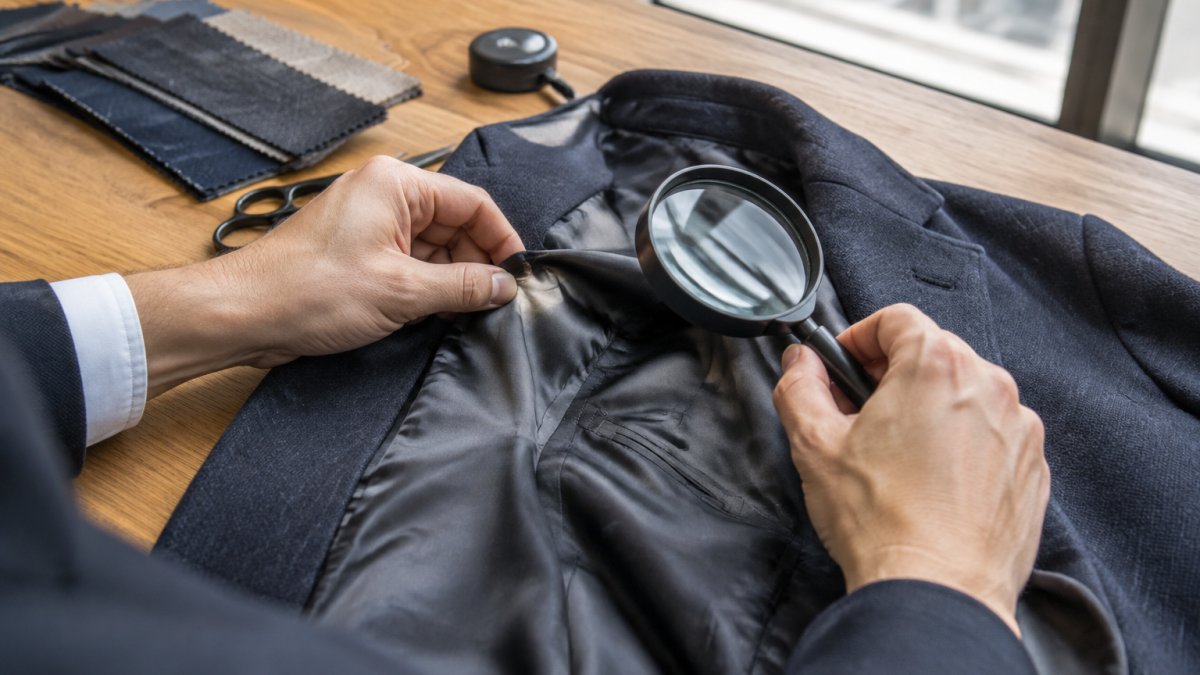
High-end garment construction is identified by four signals: stitch density, seam finishing, pattern alignment, and how the garment holds its shape when hung. These are the details that separate a tailored jacket from a convincing imitation, and they are visible to anyone who knows where to look.
Stitch density is the first check. Finer, closer stitches take more time and hold seams more securely; sparse, long stitches are a cost-saving shortcut. Look at the inside of a hem and the seam allowance, not just the outer surface.
Seam finishing is the second. Better garments enclose raw edges with binding, French seams, or clean overlocking, so the interior looks nearly as tidy as the exterior.
The fourth signal is structure. For a full walkthrough of these signals, read our guide to identifying quality craftsmanship in designer clothing.
Use this checklist before buying, and again when a piece arrives. It takes about ten minutes and works for clothing, bags, and accessories.
Fit is the fastest quality signal a garment gives off, because a well-tailored piece moves with the body instead of fighting it.
Valentino Garavani Goatskin Slip-On Loafers for Men →
Check these points when trying a piece:
Tailoring is also where construction shows. A structured blazer holds its shape on the hanger because of canvas, interfacing, and careful pressing, not because of stiffness. If a jacket feels rigid rather than shaped, it is likely fused rather than tailored, and it will not mold to you over time.
Refined color palettes do more work in a luxury wardrobe than any single statement piece. A base of neutral colors, camel, charcoal, ivory, black, and deep navy, lets texture carry the visual interest, and texture is where quality becomes visible.
Build around three layers:
Personal style grows from this discipline. When the palette is quiet, the pieces you choose say more about you, and the craftsmanship gets noticed. Vintage and resale pieces fit naturally here too, since a well-made older piece often outperforms a new fast-fashion equivalent on both texture and durability.
Cost-per-wear is the price of a piece divided by the number of times you wear it, and it is the most honest measure of investment value in a wardrobe. A $900 coat worn 150 times costs $6 per wear; a $200 coat worn ten times costs $20 per wear.
Run the math before you buy:
Resale is the second half of the value equation. Certain designers hold value far better than others, and knowing which ones changes how you think about a purchase. Our breakdown of designer clothing brands with the best resale value covers which labels retain worth and why.
Garment longevity is mostly a matter of care habits, not luck. Natural fabrics last for years when washed, stored, and repaired correctly, and the habits are simple enough to build into a routine.
Watch out: dry cleaning too often strips natural oils from wool and cashmere. Use it when the piece genuinely needs it, not as a default.
Traceability is the ability to follow a product back through its supply chain, and it is the difference between a sustainability claim you can trust and one you cannot.
Substantiated claims share a few traits. They name the specific material or process, they point to a certification or audit, and they describe the limit of the claim rather than overreaching.
Use a four-part framework to evaluate any environmental or traceability claim:
Country of origin is a useful anchor. The Federal Trade Commission's guidance on environmental marketing claims sets out how green claims should be substantiated, and it is a useful standard to hold any brand to.
Watch out: a certification logo on a hangtag does not always mean the whole product is certified, so check whether the claim applies to the fiber, the fabric, or the finished item.
Quality standards shift by category, and judging a bag by the same rules you use for a knit will mislead you. Each product type has its own tells.
For shoes, a concrete example helps. The Valentino Garavani goatskin slip-on loafers for men are made from 100% goat leather with an antiqued metal VLogo Signature front chain detail and a leather sole, made in Italy.

An investment wardrobe is built in a deliberate order, starting with the pieces worn most often and working outward. The goal is a small set of well-made items that cover most of your life, not a large set of compromises.
Start with these five:
Add from there based on gaps, not impulse. For a curated view of what belongs in a modern wardrobe, our guide to essential designer wardrobe pieces for 2026 maps the full list.
The right first investment piece is the one you will wear most often, in a material and construction you can verify, from a seller who can explain where it came from.
Three questions settle most decisions:
This is where sourcing matters as much as craftsmanship. At URBALENTI, we source authentic, brand-new designer fashion through established European networks and ship directly from Italy. For U.S. customers, free shipping is available with no minimum purchase, import duties are included in the price, and a free exchange option is available.
High-quality craftsmanship shows in the details: even stitching at a consistent stitch count, cleanly finished seams and linings, matched patterns at the seams, and hardware that feels solid rather than hollow. Materials matter just as much, so look for natural fabrics such as cashmere, silk, and full-grain leather. Together, these signals separate genuine luxury craftsmanship from mass-produced goods and help you judge whether a piece will hold up over years of wear.
Start with construction and materials rather than logos. Authentic pieces typically use natural fabrics, have symmetrical stitching, and show clean interior finishing, including bound or lined seams. Check labels, serial numbers, and hardware engravings against the brand's known format. Mass-produced items often reveal themselves through loose threads, uneven seams, synthetic lining, and lightweight hardware. Learning how to spot authentic luxury fashion is a skill built on these repeatable checks, not on brand names alone.
For leather goods, examine the grain, the edges, and the stitching. Full-grain leather shows a natural surface rather than a uniform plastic sheen, and edge finishing should be painted or burnished cleanly. Stitching should be tight and even, and hardware should feel weighty with crisp engraving. On bags, check that the lining is neatly attached and that stress points such as strap anchors are reinforced. These details are central to luxury fashion material quality standards and predict how a piece ages.
European sourcing is associated with long-established ateliers, specialist mills, and trained artisans, particularly in Italy and France, where leatherwork and tailoring traditions run deep. That heritage supports consistent material quality and finishing standards. It also gives shoppers a clearer chain of custody, which matters when verifying authenticity.
Focus on construction, materials, and versatility. Inspect stitching, lining, and hardware, confirm the fabric or leather type, and consider how many ways you will wear the piece. Calculate cost-per-wear by dividing the price by expected wears. A structured coat, a leather bag, or a pair of leather loafers often earns its place faster than a trend-driven item. Quiet luxury and timeless design tend to hold value better than seasonal statements.
Luxury in 2026 leans toward quiet luxury: fewer logos, better materials, and enduring design over seasonal novelty. Shoppers ask more about traceability, durability, and how a piece was made. Personal style and individuality now carry as much weight as brand heritage. That shift rewards craftsmanship you can inspect, such as clean tailoring, refined color palettes, and natural fabrics, and it makes investment pieces and long-term value central to buying decisions.
Quality in luxury fashion is not a mystery; it is a set of details you can learn to read. Fiber, stitch, hardware, fit, and provenance tell you most of what you need to know before you spend. Get started with URBALENTI and choose pieces built to be worn for years, backed by authentic European sourcing, transparent pricing with duties included, and free exchanges if the fit is not right.

Leave a comment