
MY WISHLIST
MY WISHLIST

TL;DR:
- Italian fashion’s global dominance results from centuries of artisanal expertise, a decentralized regional production system, and the cultural authority of the “Made in Italy” label. The industry leverages the Distretto Industriale model, preserving tacit knowledge through regional clusters that ensure exceptional quality and authenticity. Its psychological power, combined with strategic export initiatives and innovation, sustains Italy’s leadership in luxury fashion markets worldwide.
Italian fashion leads globally because it combines centuries of artisanal expertise, a decentralized production system built on tacit craft knowledge, and a brand identity so deeply embedded in cultural authority that it functions as its own category. No other country has replicated this formula at scale. The Italian fashion industry accounts for roughly 5% of Italy’s GDP in 2026, and 78% of global luxury fashion production occurs within Italian borders. Understanding why Italian fashion leads globally requires examining history, industrial structure, and consumer psychology together, not in isolation. Brands like Gucci, Prada, Valentino, and Ferragamo are not simply successful companies. They are the output of a system that took centuries to build.
Italy’s position at the top of global fashion trends did not emerge from a single moment or a single designer. It grew from a convergence of cultural, geographic, and economic forces that no other nation has matched.
The Renaissance gave Italy a visual grammar that still shapes its fashion identity today. Florentine workshops in the 15th and 16th centuries produced textiles, leather goods, and decorative arts that set European standards for beauty and precision. That tradition of treating craft as art did not disappear. It transferred, generation by generation, into the workshops that would eventually become the world’s most recognized luxury houses. Italy’s geographic beauty and rich history endow its fashion brands with an intangible added value that consumers recognize as authenticity and elegance. This is not marketing language. It is a structural advantage built over five centuries.
The modern Italian fashion industry was largely constructed between 1945 and 1970. Gucci, founded in Florence in 1921, expanded aggressively after World War II. Salvatore Ferragamo established his Florence atelier in 1927 and became the shoemaker of choice for Hollywood. Prada, founded in Milan in 1913, repositioned itself as a global luxury authority in the 1980s under Miuccia Prada. Bulgari, rooted in Roman goldsmithing since 1884, became synonymous with Italian jewelry craftsmanship. Fashion exports grew 150% from 1950 to 1956, establishing the economic foundation that would sustain Italy’s dominance for decades. That growth rate reflects a deliberate national strategy, not organic luck.
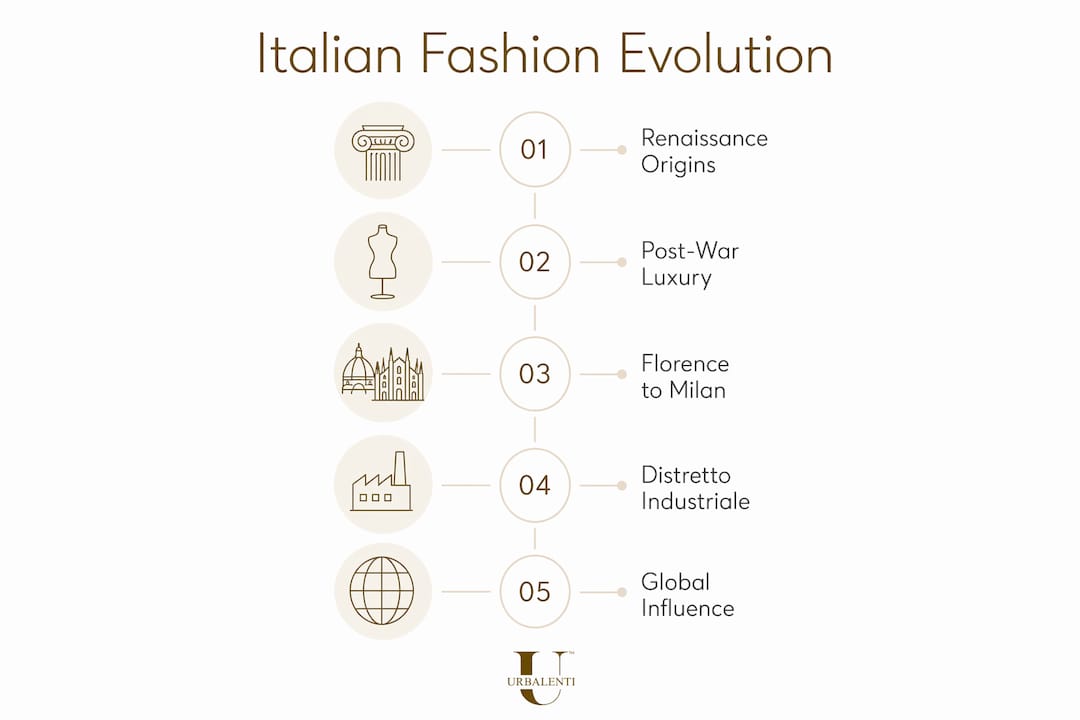
Florence hosted the first major Italian fashion shows in the early 1950s, organized by Giovanni Battista Giorgini at Villa Torrigiani. By the 1970s and 1980s, Milan had taken over as Italy’s primary fashion capital. Milan offered proximity to textile manufacturing in Lombardy, financial infrastructure, and a concentration of design talent that Florence could not match at scale. Today, Milan Fashion Week sits alongside Paris, New York, and London as one of the four fashion capitals of the world, drawing buyers, editors, and press from every major market. The city’s role is not ceremonial. It is operational.
Pro Tip: If you want to understand Italian style dominance, study the geography. Tuscany produces leather. Como produces silk. Naples produces tailoring. Each region feeds the whole system with specialized knowledge that no single factory can replicate.
The Distretto Industriale is the industrial structure that makes Italian fashion’s quality claims credible. It is a decentralized production model where small and medium enterprises cluster geographically around a shared craft specialty, sharing knowledge, suppliers, and skilled labor within a defined region.
The Distretto Industriale model enables artisanal specialization and tacit knowledge transfer that mass manufacturing cannot replicate. Tacit knowledge is the kind of expertise that cannot be written in a manual. It lives in the hands of a leather tanner in Tuscany who learned his technique from his father, or a silk weaver in Como who adjusts tension by feel rather than measurement. This knowledge transfers through apprenticeship and proximity, not through training programs or production manuals.
Here is how the model works in practice:
“Made in Italy is treated by brands as a founding narrative, not just an origin label.” — The global appeal of Made in Italy in fashion
This distinction matters enormously. When Gucci or Valentino references Italian craftsmanship, they are not invoking a geographic footnote. They are describing the core of their product identity. The Distretto Industriale is the reason that claim holds up under scrutiny.
“Made in Italy” functions as a semiotic shortcut. It compresses a complex set of quality signals, cultural associations, and aesthetic values into three words that consumers across markets recognize and respond to without requiring further explanation.
65% of consumers associate Italian products immediately with fashion, and 70% report willingness to pay a premium for Italian goods. That premium is not purely rational. It reflects emotional and aesthetic value that consumers assign to the origin label itself, independent of a side-by-side quality comparison. When a consumer pays more for an Italian-made bag, they are purchasing a story, a set of values, and a cultural affiliation alongside the physical object.
| Origin label | Primary association | Premium driver | Vulnerability |
|---|---|---|---|
| Made in Italy | Craftsmanship, elegance, heritage | Cultural authority and aesthetic identity | Counterfeiting and label misuse |
| Made in France | Haute couture, perfumery, gastronomy | Institutional prestige (LVMH, Kering) | Perceived exclusivity limits accessibility |
| Made in Japan | Precision, minimalism, technology | Engineering reputation | Less dominant in apparel specifically |
| Made in USA | Casualwear, denim, sportswear | Lifestyle and cultural export | Limited luxury fashion association |
Italy’s origin label is the only one that commands a premium specifically in fashion across both apparel and accessories, at both the ultra-luxury and accessible luxury price points. That breadth is unique.
Italy’s fashion leadership is also protected from socio-political instability perceptions. Research shows no correlation between negative views of Italy’s domestic political climate and consumer attitudes toward Italian products. This insulation is rare. Most country-of-origin brands suffer when the country faces reputational challenges. Italy’s fashion identity operates independently of its political one.
Pro Tip: For industry professionals evaluating sourcing decisions, the “Made in Italy” label carries measurable commercial value. Brands that move production offshore to reduce costs often find that the price premium they lose exceeds the manufacturing savings they gain.
The psychological dimension of Italian fashion influence also extends to brand authenticity. Consumers increasingly scrutinize whether a brand’s heritage claims are genuine. Italian houses that maintain production in their founding regions carry a credibility that newer brands attempting to simulate Italian aesthetics cannot replicate.
Italian fashion’s global strategy in 2026 is not nostalgic. The industry combines its heritage positioning with active export development, digital marketing, and sustainability investment to stay relevant across generations and markets.
Italy’s exports to the US exceed 70 billion euros annually, with fashion representing a significant share of that figure. The US market is the single largest destination for Italian luxury goods, and Italian brands have responded with dedicated retail investments, pop-up activations, and partnerships with American retailers and cultural institutions. This is not passive export. It is active market development.
Key factors sustaining Italian fashion’s global leadership in 2026:
The designer fashion trends of 2026 reflect Italian influence at every level, from the construction of tailored outerwear to the color palettes that define the season. Italian style dominance is not a historical artifact. It is a present-tense reality.
Italian fashion leads globally because its artisanal production system, cultural heritage, and the psychological authority of “Made in Italy” together create a competitive position that no other country has replicated at scale.
| Point | Details |
|---|---|
| Historical foundation | Renaissance craft traditions and post-WWII brand building created Italy’s fashion infrastructure over centuries. |
| Distretto Industriale model | Decentralized regional clusters preserve tacit artisanal knowledge that mass manufacturing cannot replicate. |
| “Made in Italy” premium | 70% of consumers pay more for Italian goods due to emotional and aesthetic brand value, independent of direct quality comparison. |
| Political insulation | Italy’s fashion reputation shows no correlation with domestic political instability, making it uniquely resilient among origin brands. |
| Active global strategy | Italy’s exports to the US exceed 70 billion euros annually, supported by Milan Fashion Week and Italian Trade Association programs. |
I have spent years working with Italian designer collections, and the question I hear most often from industry professionals is some version of: “Why can’t other countries just do what Italy does?” The answer is that they are asking the wrong question.
Italy’s advantage is not a strategy that can be copied in five years. It is a system that accumulated over five centuries. The leather tanner in Santa Croce sull’Arno is not just a supplier. He is the repository of knowledge that took three generations to build. When a brand like Ferragamo or Gucci sources from that tannery, they are accessing something that cannot be procured from a different country at any price.
What I find most underappreciated in discussions about Italian fashion influence is the role of geographic density. The fact that a silk weaver in Como, a leather specialist in Tuscany, and a cashmere producer in Biella are all within a few hours of Milan is not incidental. It means that designers, manufacturers, and suppliers operate in continuous conversation. Problems get solved faster. Quality standards get enforced more directly. New ideas get tested in real production environments rather than in isolated R&D facilities.
The brands that engage with this system most authentically, rather than treating Italy as a label to attach to offshore production, are the ones that sustain genuine consumer loyalty. That distinction is becoming more visible to consumers, not less. The luxury fashion collections that hold their value over time are almost always the ones where Italian craftsmanship is structural, not decorative.
For industry professionals looking to engage with Italian fashion at a serious level, the advice is straightforward. Study the regions, not just the brands. Understand what Tuscany produces versus what Biella produces versus what Naples produces. That geographic literacy will tell you more about why a garment costs what it costs than any brand narrative ever will.
— Admin Urbalenti
The principles behind Italy’s global fashion dominance are visible in every piece Urbalenti™ NYC carries. Curated in New York and fulfilled directly from Milan, the Urbalenti™ selection brings the output of Italy’s finest production regions to clients worldwide.
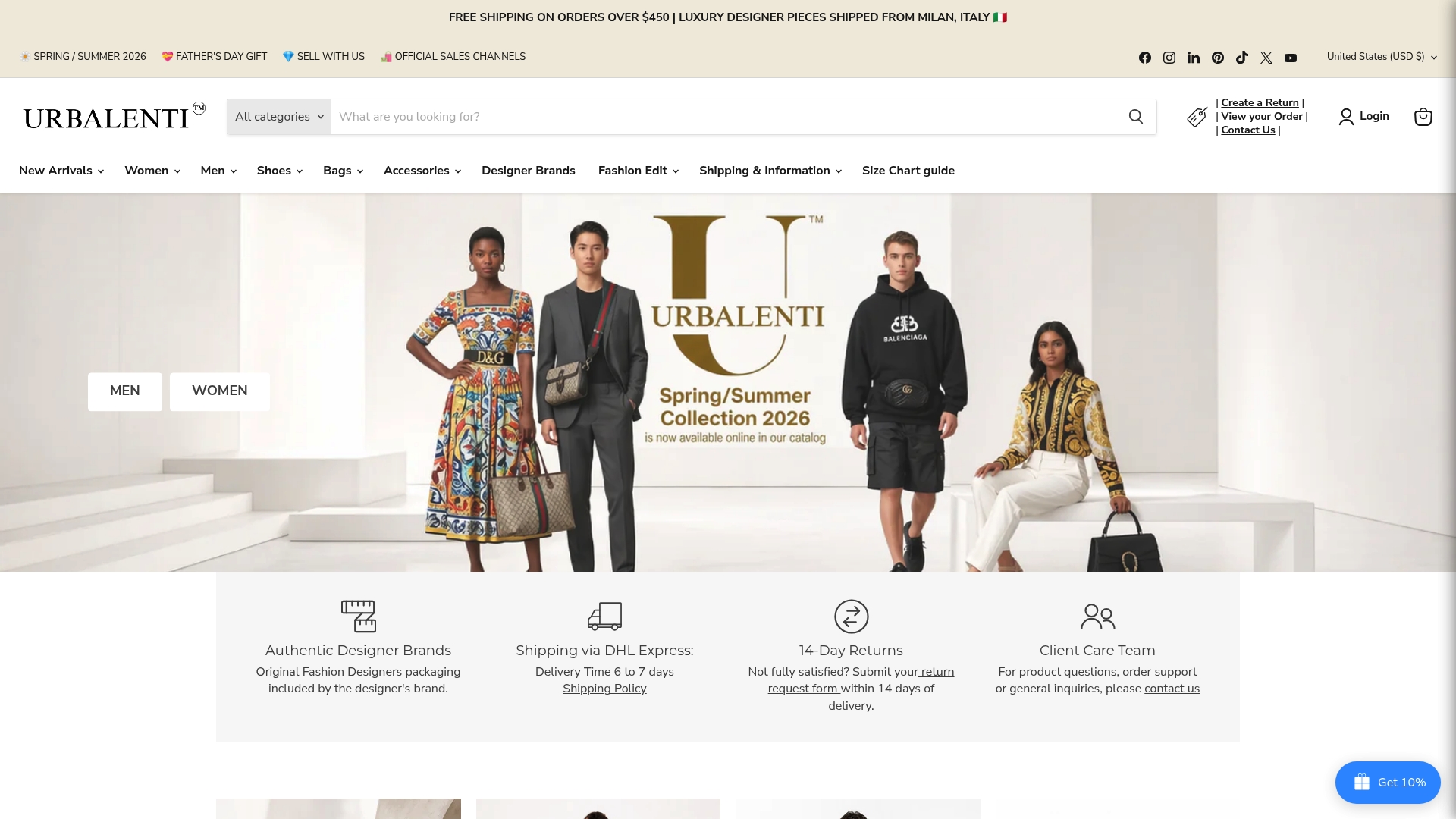
From the Saint Laurent cashmere sweater to the Dolce & Gabbana logo t-shirt in Italian cotton, each piece in the Urbalenti™ catalog reflects the craftsmanship and cultural authority that make Italian fashion the global benchmark. Every client receives VIP-level service from selection through delivery, with DHL Express shipping available worldwide. Authentic. Curated. Fulfilled from Milan.
Italian fashion dominates global luxury markets because of its combination of centuries-old artisanal expertise, the Distretto Industriale production model, and the “Made in Italy” label, which 65% of consumers globally associate directly with fashion quality and prestige.
The Italian fashion industry contributes approximately 5% of Italy’s GDP in 2026, with exports to the US alone exceeding 70 billion euros annually. Fashion exports grew 150% between 1950 and 1956, establishing the economic foundation that sustains Italy’s global position today.
“Made in Italy” is the only origin label that commands a premium specifically in fashion across both apparel and accessories at multiple price points. Research shows 70% of consumers pay more for Italian goods based on emotional and aesthetic value, and the label’s reputation is insulated from Italy’s domestic political climate.
The Distretto Industriale clusters small and medium enterprises geographically around a shared craft specialty, such as leather tanning in Tuscany or silk weaving in Como. This structure preserves tacit artisanal knowledge passed down through generations, which mass manufacturing in other countries cannot replicate.
Gucci, Prada, Valentino, Dolce & Gabbana, Ferragamo, and Emporio Armani are among the Italian houses maintaining multi-billion euro annual revenues in 2026. Each brand combines heritage positioning with active global marketing through Milan Fashion Week and direct-to-consumer digital channels.
Leave a comment